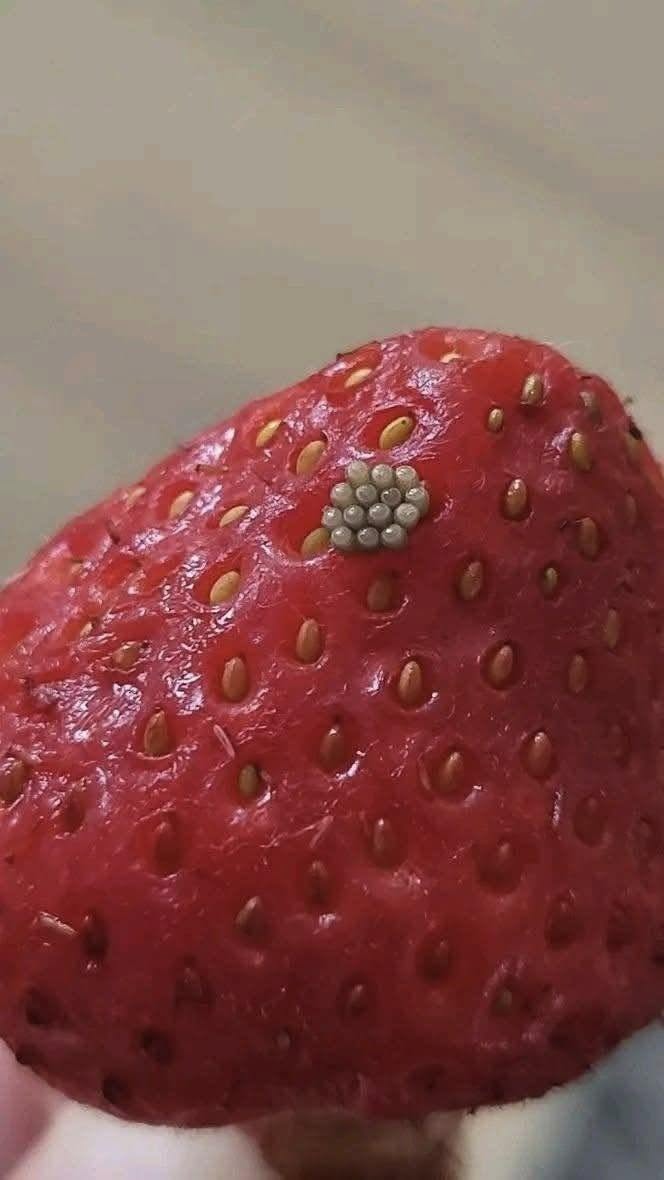
Some online discussions suggest that finding larvae proves strawberries are organic or that conventional pesticides were not used. This conclusion is too simplistic.
Organic agriculture does not mean that crops are completely free of pesticides. Organic growers may use certain pest-control products permitted under their certification standards, alongside physical, biological, and cultural control methods.
Conventional farms also use a range of approaches, including monitoring, sanitation, insecticides where appropriate, and other integrated pest-management practices.
The presence or absence of larvae cannot reliably tell you whether a strawberry was grown organically or conventionally.
Insect pressure depends on many factors, including:
Local climate and temperature.
The number of fruit flies in the surrounding environment.
The timing of harvesting.
The variety of strawberry.
Field sanitation and pest-monitoring practices.
The effectiveness and timing of pest-management measures.
Transportation and storage conditions.
A well-managed farm can still experience occasional pest damage. Likewise, a strawberry with no visible insects is not proof that no pest-control products were used.
If you prefer organic produce, look for a recognized certification and buy from suppliers who can explain their growing practices. If you prefer conventionally grown produce, choose reputable sellers and follow ordinary food-washing practices.
Neither label should be treated as a guarantee that every individual berry is completely free of insects.
5. Does Washing Strawberries Remove All Pesticide Residues?
Washing fresh produce under clean running water is a useful food-safety practice, but it has limitations.
It can remove soil, dust, some surface microorganisms, and some pesticide residues. The effectiveness depends on the type of substance, how it was applied, and whether it remains on the surface or has entered the plant tissue.
Washing cannot be expected to remove every pesticide residue.
For this reason, consumers should not rely on salt, vinegar, baking soda, or other household mixtures as a guaranteed way to eliminate pesticides.
There is also no need to use soap, detergent, bleach, or household cleaning products on strawberries. These products are not intended for washing food and may leave residues of their own.
A practical approach is to:
Wash your hands before handling the fruit.