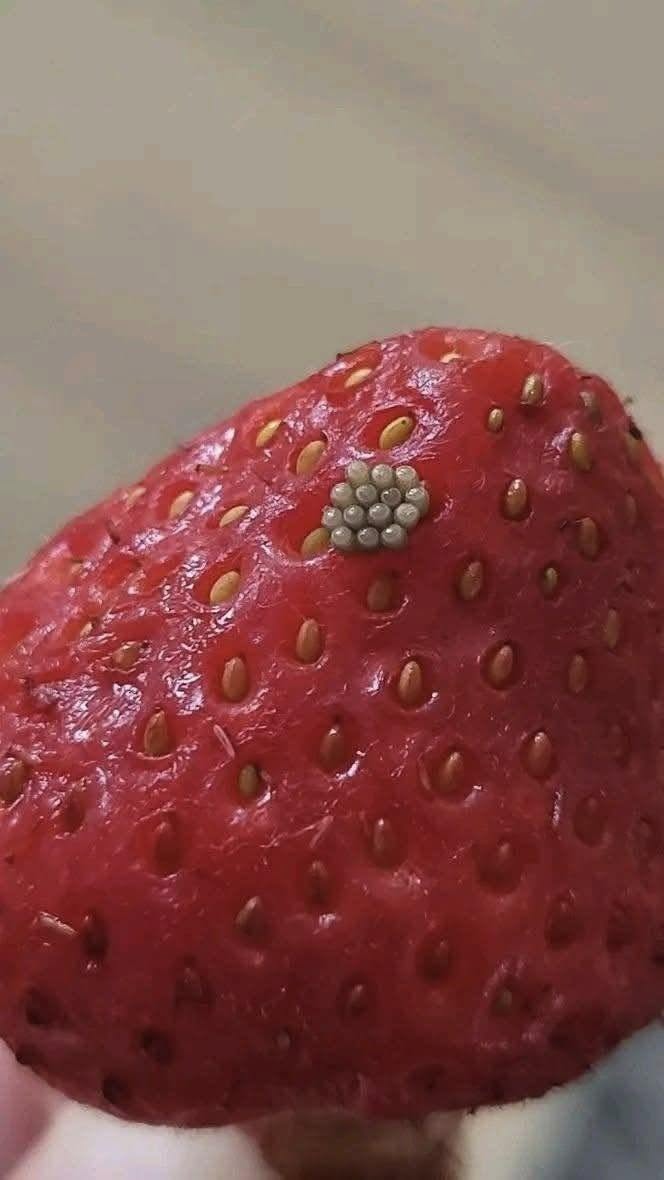
Several kinds of small insects can develop in or around fruit. Their larvae may look similar to an untrained observer, particularly when they are only a few millimeters long.
The appearance of a tiny white, worm-like creature is not enough to confirm its species. Proper identification may require examining its physical characteristics, the fruit in which it was found, and sometimes its development into an adult insect.
This distinction matters because viral videos often present a specific identification as though it were certain. In reality, the same visual observation may have more than one explanation.
The practical lesson is simple: do not assume that every white object or moving larva found in fruit is a spotted wing drosophila. If you repeatedly find insects in purchased fruit, take a photograph and contact the seller or an appropriate agricultural or food-safety authority for identification.
2. How Do Fruit Fly Larvae Develop Inside Fresh Fruit?
To understand why larvae can appear in apparently healthy strawberries, it helps to understand the insect’s life cycle.
The spotted wing drosophila begins its life as an egg. A female uses a specialized egg-laying structure to insert eggs beneath the skin of suitable fruit.
After the eggs hatch, the larvae feed on the soft fruit tissue. As they grow, they continue developing inside the fruit until they reach the next stage of their life cycle.
Eventually, the mature larvae leave the fruit and develop into pupae. An adult fly later emerges, completing the cycle.
The process can happen without obvious signs on the outside of the berry.
A strawberry may still look red, fresh, and attractive even when a small larva is developing inside it. This is one reason growers monitor fruit carefully rather than relying only on its external appearance.
Infestation can also increase the likelihood of secondary spoilage. When insects damage fruit tissue, microorganisms may have an easier opportunity to enter and multiply.
That does not mean every infested strawberry is dangerous. It means that insect damage and food spoilage are two separate issues that should be considered together.
3. Why Are Strawberries Particularly Vulnerable?
Strawberries have several characteristics that make them attractive to insects.
First, they have relatively soft flesh. Unlike fruits with thick, hard skins, strawberries offer a more accessible environment for small insects.
Second, ripe strawberries contain sugars, moisture, and nutrients that support the development of many organisms.
Third, their growing conditions can provide opportunities for insects to feed and reproduce. Strawberry plants are often grown close to the soil, where moisture, vegetation, and other organisms are present.
The fruit’s delicate structure also means that bruises, cracks, and damaged areas can develop easily during harvesting, transportation, and storage.
Once a berry becomes overripe or damaged, it may attract a wider range of insects and microorganisms.
This is why harvesting at the appropriate stage, removing damaged fruit, maintaining field sanitation, and keeping harvested strawberries cool are important parts of commercial production.
It is also why consumers should pay attention to the condition of berries rather than judging their quality by color alone.
A bright red strawberry is not automatically perfect, and a slightly uneven strawberry is not necessarily unsafe.
4. Does Finding Larvae Mean the Strawberries Were Grown Without Pesticides?
Not necessarily.