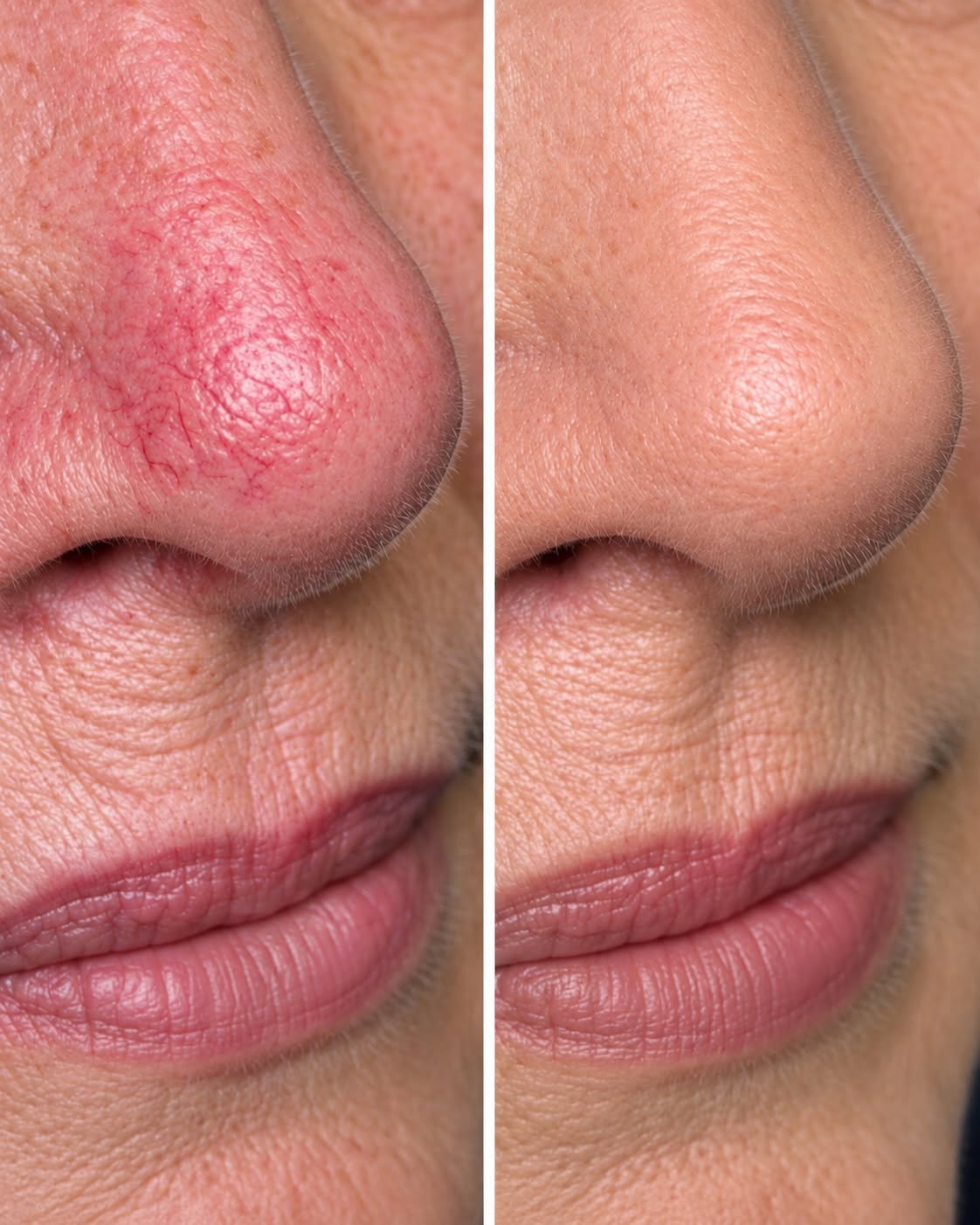
Prepare the skin. Cleanse gently and apply a moisturizer suited to your skin. Allow it to settle before adding makeup.
Use sunscreen in the morning. Choose broad-spectrum protection that you tolerate well. Let it dry according to the product instructions.
Apply a small amount of green corrector. Focus on the red areas around the nostrils rather than covering the entire nose.
Blend without rubbing. Use clean fingertips, a soft brush, or a sponge. Press or tap gently instead of dragging the product across sensitive skin.
Add a thin layer of foundation or concealer. Build coverage gradually, stopping when the redness is sufficiently softened.
Set only where needed. If makeup tends to settle into dry texture, heavy powder may make it more obvious. Use a small amount and avoid overloading the area.
This technique can make redness less noticeable, but it does not shrink blood vessels or treat the cause of the redness. Think of it as a cosmetic solution that works alongside, rather than instead of, appropriate skincare.
The product formula matters too. If a corrector contains fragrance or ingredients that irritate your skin, it may make the problem worse. Test a new product on a small area first and discontinue it if you develop a reaction.
For people with very sensitive skin, a green-tinted moisturizer or sunscreen may be more comfortable than layering several separate products. The best choice is the one that provides the coverage you want without causing irritation.
Remember that makeup does not have to eliminate every trace of natural skin texture. The goal is a comfortable, natural-looking result—not a perfectly airbrushed nose at the cost of skin irritation.
7. Choose a Gentle Cleanser Instead of Scrubbing the Redness Away
When redness appears around the nostrils, it is tempting to scrub the area or use a cleanser designed to remove oil and impurities. However, the skin in this area can be sensitive, and vigorous cleansing may make irritation more noticeable.
A gentle cleanser should remove everyday dirt, sunscreen, excess oil, and makeup without leaving the skin feeling stripped. Look for a product labeled gentle or suitable for sensitive skin, and avoid formulas that consistently leave your face tight or burning.
You generally do not need to wash your face repeatedly throughout the day. For many people, cleansing in the evening and rinsing or gently cleansing in the morning is sufficient, depending on skin type and activity. If you exercise heavily or sweat, wash away sweat and residue without aggressively rubbing the skin.
Water temperature matters as well. Very hot water can increase flushing and aggravate discomfort, particularly for people with rosacea-prone skin. Use lukewarm water and pat the face dry with a soft towel instead of rubbing it.
Be cautious with facial brushes, rough washcloths, exfoliating gloves, and abrasive scrubs. These tools can be too harsh for skin that is already red or reactive. The fact that a product removes flakes does not necessarily mean it is improving the underlying condition.
If you wear long-lasting makeup, remove it thoroughly but gently. Avoid repeatedly rubbing the sides of the nose to remove every trace of foundation. A suitable makeup remover followed by a gentle cleanser may work better than prolonged friction.
After cleansing, apply moisturizer while the skin is still slightly damp if that feels comfortable. This can help reduce moisture loss and make the skin feel less tight.
A simpler routine is often easier to maintain and makes it easier to identify which product causes a reaction. If you introduce five new products at once, it becomes difficult to determine which one is helping and which one may be aggravating the redness.