How to Clean a Very Dirty Oven in Stages
If years of residue have accumulated, trying to remove everything at once may lead to excessive scrubbing and surface damage.
A staged method can work better.
Stage 1: Remove Loose Debris
Vacuum or brush away crumbs, charred food pieces, and loose flakes.
Stage 2: Soften Grease
Apply an approved cleaner or compatible diluted detergent and give it time to work.
Stage 3: Wipe the Easy Layer
Remove loosened residue without excessive force.
Stage 4: Repeat Only Where Necessary
Treat remaining stubborn spots rather than reapplying strong cleaner to the entire oven.
Stage 5: Rinse Carefully
Use several passes with clean damp cloths.
Stage 6: Dry Completely
Allow moisture to evaporate before using the appliance.
How Often Should You Clean an Oven?
There is no universal schedule because cleaning frequency depends on how often the oven is used and what you cook.
Someone who frequently roasts fatty foods may need to clean more often than someone who mainly bakes bread or reheats dishes.
The most effective strategy is to wipe spills early before repeated heating turns them into hard carbonized deposits.
Clean Major Spills After the Oven Cools
If cheese, sauce, fat, or sugary filling spills during cooking, allow the oven to cool and remove the residue as soon as practical.
Sugary spills can become particularly stubborn after repeated heating.
Use Baking Trays to Catch Drips Correctly
Place foods likely to overflow on an appropriate baking tray or sheet pan.
Do not line the oven floor with aluminum foil unless the manufacturer explicitly permits it.
Why Foil on the Oven Floor Can Be a Problem
Covering the bottom of some ovens with foil can interfere with airflow and heat distribution.
It may also damage enamel or heating components depending on the oven design.
Use removable trays on approved rack positions instead.
How to Reduce Future Grease Buildup
Wipe fresh spills once the oven has cooled
Use covered roasting dishes when appropriate
Use adequately sized baking trays
Avoid overfilling dishes that may bubble over
Clean the door glass regularly
Inspect racks before heavy deposits form
Use manufacturer-approved cleaning cycles when available
Why a Clean Oven Can Perform Better
A dirty oven does not automatically become dramatically inefficient, but heavy deposits can create smoke, unpleasant smells, staining, and uneven surfaces that make the appliance less pleasant to use.
Grease near heating areas may smoke whenever the oven becomes hot.
Regular cleaning helps prevent these problems.
What Causes Smoke From a Dirty Oven?
Old fat and food residue can heat beyond their normal cooking temperature and begin smoking.
If smoke appears after a recent spill, allow the oven to cool and clean the affected area.
Persistent electrical smells, unusual sparks, or smoke not clearly linked to food residue may indicate an appliance problem and should be investigated appropriately.
What If the Oven Smells Like Cleaner After Cleaning?
A strong detergent smell suggests residue may remain.
Do not simply mask it with food or fragrance.
Once the oven is cool, wipe it repeatedly with fresh clean water and ventilate the area.
Follow the appliance manual before heating the oven again.
Do You Need to “Burn Off” the Cleaner?
It is better to remove cleaning residue physically with clean water rather than relying on high heat to burn it away.
Heating residual detergent may create unpleasant fumes.
Can Dishwasher Tablets Scratch Oven Glass?
A dissolved solution used with a soft cloth is less abrasive than rubbing a hard tablet directly over glass.
Some tablets contain granular ingredients, so vigorous rubbing can potentially scratch sensitive surfaces.
When in doubt, use a non-abrasive cleaning method recommended by the oven manufacturer.
Can Dishwasher Tablets Damage Enamel?
Oven enamel is generally durable, but cleaners differ in alkalinity and formulation.
Repeated use of harsh chemicals or abrasive scrubbing may dull or damage some finishes.
Testing a small area and following the manufacturer’s guidance reduces this risk.
Can Dishwasher Tablets Damage Rubber Seals?
Strong detergents should not be left sitting on rubber or silicone seals unnecessarily.
If detergent touches a gasket, wipe it away with clean water and dry the area.
Can This Method Be Used on a Microwave Oven?
A conventional oven and a microwave are not the same appliance.
Do not automatically use dishwasher-tablet cleaning methods inside a microwave.
Follow the microwave manufacturer’s recommended cleaning procedure instead.
Can It Be Used in an Air Fryer?
Air fryers often contain nonstick coatings, heating elements, fans, and electronic components that may not tolerate dishwasher detergent.
Some removable baskets are dishwasher-safe while others have specific cleaning restrictions.
Follow the appliance manufacturer’s instructions rather than extending the oven trick to every kitchen appliance.
Common Oven-Cleaning Mistakes
Mistake 1: Cleaning While the Oven Is Still Hot
A hot oven increases burn risk and can cause cleaner to dry or react differently than expected.
Mistake 2: Using Too Much Product
More detergent does not automatically mean better cleaning.
Excess product simply creates more residue that needs to be rinsed away.
Mistake 3: Mixing Several Cleaners
Combining chemicals can cause harmful reactions or make the mixture unpredictable.
Mistake 4: Scrubbing With Metal Tools
Knives, razor blades, steel wool, and metal scrapers can permanently scratch surfaces unless a specific tool is approved for that particular oven glass or finish.
Mistake 5: Forgetting to Rinse
A visually clean oven can still contain detergent residue.
Rinse until surfaces no longer feel slippery or soapy.
Mistake 6: Ignoring the Oven Manual
The appliance manual is more relevant to your specific oven than a generalized internet cleaning hack.
Manufacturers know which coatings, materials, and self-cleaning systems are used in the appliance.
Mistake 7: Getting Water Into Vents
Ovens contain areas where liquid should not accumulate.
Use damp cloths rather than pouring water directly into the appliance.
Mistake 8: Cleaning Catalytic Panels Like Ordinary Enamel
Catalytic surfaces require special care and may be damaged by detergent or scrubbing.
Mistake 9: Forgetting Gloves
Dishwasher detergent can irritate skin, particularly in concentrated form.
Mistake 10: Expecting One Tablet to Restore Every Oven to Factory Condition
Some stains and discoloration become permanent with age and repeated heating.
A cleaner oven is a realistic goal; a perfectly new-looking oven is not always possible.
Frequently Asked Questions
Can a dishwasher tablet really clean an oven?
It can help loosen grease and some baked-on food residue because dishwasher detergents contain ingredients designed to break down food soils. However, the method is not appropriate for every oven surface.
Is a dishwasher tablet safe for every oven?
No. Catalytic liners, aluminum components, special coatings, seals, electrical parts, and certain self-cleaning systems may require different cleaning methods.
Should I dissolve the tablet first?
Dissolving it in warm water creates a less abrasive solution and makes it easier to control how much detergent is applied.
Can I use the tablet directly on the oven glass?
Some people do, but a hard or granular tablet may be abrasive. A diluted solution with a non-scratch sponge is a more cautious option.
How long should I leave the solution on?
For moderate grease, approximately 10 to 20 minutes may help soften residue, provided the surface is compatible and the detergent does not dry completely.
Do I need gloves?
Gloves are recommended because concentrated dishwasher detergent can irritate or dry the skin.
Can I clean a hot oven this way?
No. Switch the oven off and let it cool completely before applying detergent.
Can I heat the oven with the dishwasher tablet inside?
Do not use this as a general cleaning method. Dishwasher detergent is not designed to be heated in a dry oven.
Can I mix the tablet with vinegar?
There is usually no benefit. Many dishwasher detergents are alkaline while vinegar is acidic, so they can partly neutralize each other. Use one cleaner at a time.
Can I mix dishwasher detergent with bleach?
No. Avoid mixing household cleaning chemicals. Use one product according to its instructions and rinse thoroughly.
Can I use a dishwasher tablet on oven racks?
Possibly, if the rack material and manufacturer allow it. Be particularly cautious with aluminum or coated accessories.
Can I use it on aluminum baking trays?
Strong alkaline dishwasher detergent can discolor or damage aluminum, so it should generally be avoided unless the manufacturer specifically says the item is dishwasher-safe.
Will one tablet remove years of burnt grease?
It may loosen some deposits, but severe carbonized residue may require repeated cleaning or a manufacturer-approved oven cleaner.
Can dishwasher detergent damage oven enamel?
Some enamel surfaces tolerate mild cleaning well, but formulations vary. Always spot-test and follow the appliance instructions.
Why does my oven still smell after cleaning?
Detergent residue may remain. Wipe the oven repeatedly with a clean damp cloth and ventilate it thoroughly.
Should I run the oven immediately after cleaning?
Make sure the interior has been thoroughly rinsed and dried first, and follow any post-cleaning instructions in your appliance manual.
Can I clean the fan with the solution?
Avoid pouring or spraying liquid into fan vents or electrical areas. Clean only removable components according to manufacturer instructions.
Can I clean the door gasket?
Use gentle cleaning methods recommended for the gasket. Do not soak or aggressively scrub it.
Is dishwasher detergent better than oven cleaner?
Neither is universally better. Dishwasher detergent may help with moderate grease, while dedicated oven products are formulated specifically for baked-on oven deposits. Surface compatibility and safe use matter more than the label.
Is This Trick Worth Trying?
For a standard compatible oven with moderate grease, a carefully diluted dishwasher-tablet solution can be a useful cleaning option.
The trick works best when it is treated as a grease-loosening method rather than a miracle cure.
The safest version follows five basic principles:
Check the oven manual first
Work only on a completely cool appliance
Avoid sensitive components and special coatings
Wear gloves and avoid mixing cleaners
Rinse every cleaned surface thoroughly afterward
A Simple Cleaning Routine
If your oven is compatible with the method, the process can be summarized like this:
Switch off and cool the oven completely.
Remove racks and loose debris.
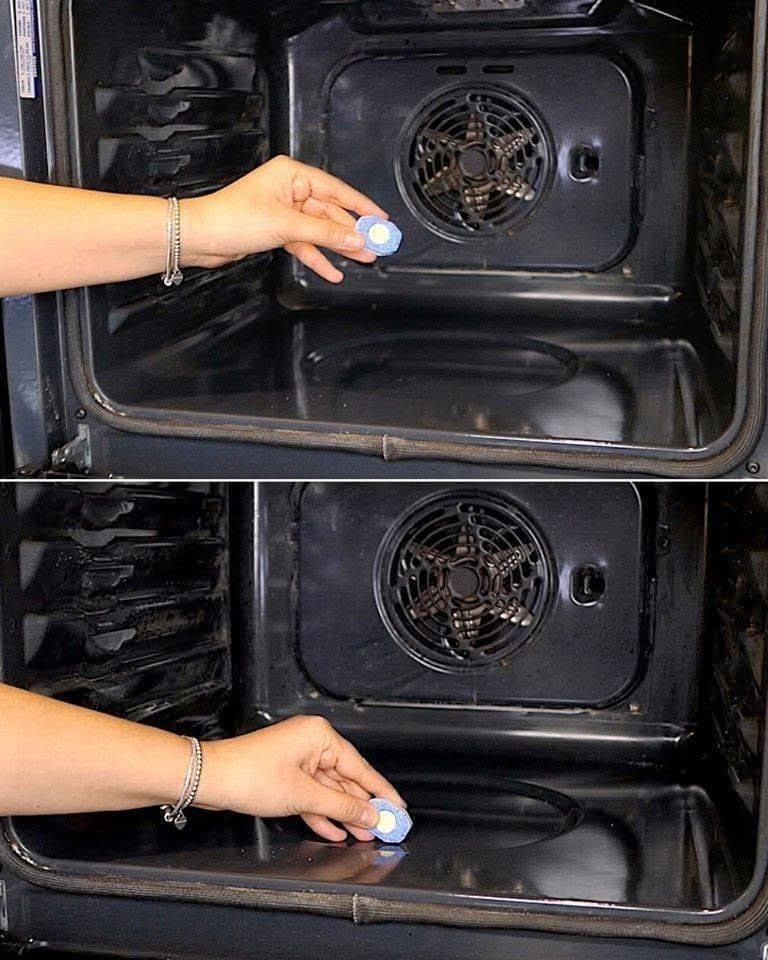
Dissolve one dishwasher tablet in warm water.
Spot-test an inconspicuous area.
Apply a small amount to greasy compatible surfaces.
Allow it to soften residue for a short period.
Wipe gently with a non-scratch sponge.
Rinse repeatedly with clean water.
Dry and ventilate the appliance.
Return the racks only when everything is clean and dry.
Final Thoughts
A dishwasher tablet can do more than clean plates and cutlery. Its grease-cutting ingredients may also help loosen stubborn food deposits inside certain ovens.
But the popular claim that “all you need is one dishwasher tablet and your oven will be like new” leaves out an important part of the story.
Modern ovens contain many different materials and specialized surfaces. A cleaner that works beautifully on standard enamel may be unsuitable for catalytic liners, aluminum accessories, heating elements, seals, or sensitive coatings.
For that reason, always check the appliance manufacturer’s instructions before trying an unconventional cleaning method.
If the method is compatible with your oven, dissolve the tablet rather than relying on aggressive dry scrubbing, use gloves, keep liquid away from electrical components and vents, and give the detergent enough time to loosen the grease.
Most importantly, rinse thoroughly with clean water so no detergent remains before the oven is used for cooking again.
Used carefully, the dishwasher-tablet trick can be an inexpensive way to deal with greasy oven residue. Used carelessly, it can leave detergent behind or damage surfaces that were never designed for this type of cleaner.
The real secret to keeping an oven looking good is not one powerful cleaning trick. It is removing spills regularly, using the correct cleaner for the appliance, and preventing layers of grease from being baked on repeatedly in the first place.