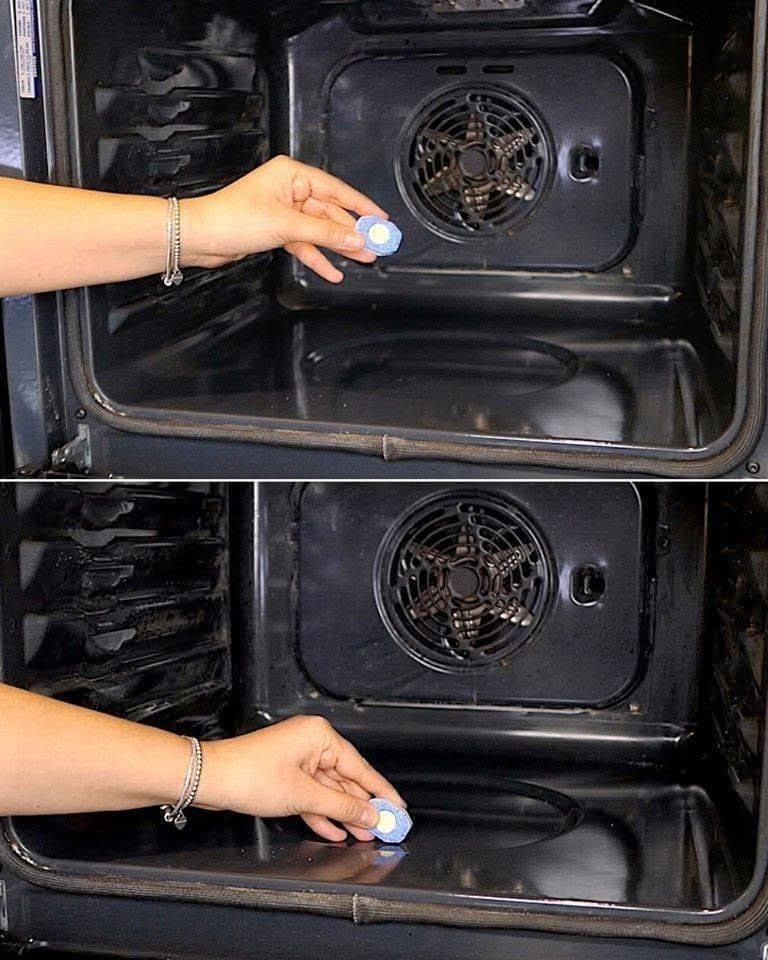
Can You Rub a Dishwasher Tablet Directly on Oven Glass?
Some online demonstrations dip a solid tablet in water and rub it directly across the oven door.
This can sometimes remove baked-on grease, but it is a more abrasive method than using dissolved detergent.
Depending on the tablet and glass surface, rubbing too aggressively could scratch or dull sensitive finishes.
A diluted solution and non-scratch sponge is the more cautious approach.
Can You Put a Dishwasher Tablet in the Oven and Heat It?
This is not recommended as a general cleaning technique.
Dishwasher tablets are designed to dissolve inside a dishwasher with controlled amounts of water, temperature, and rinsing.
Heating a tablet or detergent solution in an oven can release irritating vapors or cause residues to bake onto surfaces.
If your oven has a steam-clean function, use it according to the manufacturer’s instructions rather than improvising with detergent.
Can You Put a Bowl of Dishwasher Detergent in a Hot Oven?
It is better not to improvise with chemical steam-cleaning methods.
A bowl of plain water is sometimes used in manufacturer-approved steam-cleaning procedures, but adding dishwasher chemicals changes the situation.
Only use products explicitly approved for the appliance.
Do Not Mix Dishwasher Tablets With Other Cleaners
Combining household cleaning products is unnecessary and can sometimes create hazardous reactions.
Do not mix dishwasher detergent with:
Chlorine bleach
Ammonia cleaners
Strong acids
Toilet cleaners
Drain cleaners
Other unidentified cleaning chemicals
The safest rule is to use one cleaning product at a time and rinse thoroughly before introducing another.
What About Vinegar and Dishwasher Tablets?
Vinegar is acidic, while many dishwasher detergents are alkaline.
Mixing them can partially neutralize their cleaning chemistry rather than producing a magical super-cleaner.
More importantly, combining products unnecessarily makes it harder to predict how they will behave on oven coatings and components.
Use one method at a time.
What About Baking Soda?
Baking soda is often used as a mild abrasive cleaning paste.
It can sometimes help loosen light baked-on residue when combined with water.
However, it also leaves powdery residue that must be wiped away thoroughly.
Some special oven coatings should not be scrubbed with abrasive pastes, so manufacturer guidance still applies.
Dishwasher Tablet Versus Commercial Oven Cleaner
Commercial oven cleaners are specifically formulated for extremely stubborn baked-on grease, but many are also strongly alkaline and require careful use.
Dishwasher tablets may be more convenient for moderate cleaning, but they are not necessarily gentler simply because they are familiar household products.
Both types of cleaner should be used with gloves, ventilation, and careful rinsing according to their labels.
Natural Does Not Automatically Mean Safer
Another common misconception is that homemade methods are always safer than commercial cleaners.
Vinegar can damage certain stone surfaces. Baking soda can scratch delicate finishes. Concentrated acids can irritate skin and eyes. Dish soap can leave difficult residue.
Cleaning safety depends on chemistry, concentration, surface compatibility, and correct use—not whether the product came from a kitchen cupboard.
What About a Pyrolytic Self-Cleaning Oven?
Pyrolytic ovens use extremely high temperatures during a dedicated self-cleaning cycle to reduce baked-on food deposits to ash.
If your oven includes this system, follow the manufacturer’s instructions regarding racks, trays, and what must be removed before running the cycle.
Do not automatically apply dishwasher detergent before activating a pyrolytic cycle.
Never Leave Cleaner Inside During a Self-Cleaning Cycle
Self-cleaning cycles reach temperatures far higher than ordinary baking.
Cleaning chemicals that are not designed for those temperatures should not be left inside.
Remove cleaning residue completely before using the oven.
What About Catalytic Ovens?
Catalytic liners contain a special porous surface designed to absorb grease during cooking and break it down at elevated temperatures.
Strong detergents and aggressive scrubbing may damage this coating.
If you see rough, matte, dark panels on the oven walls, consult your manual before cleaning them.
What About Steam-Cleaning Ovens?
Some ovens have a low-temperature steam-cleaning program.
These cycles typically use water to soften fresh food residue so it can be wiped away afterward.
Use the amount of water and procedure recommended by the manufacturer rather than adding detergent unless specifically instructed.
Cleaning Around the Oven Fan
Grease can accumulate near convection fan covers.
Do not pour liquid into fan openings.
If the fan cover is removable according to the appliance manual, clean it using the recommended procedure.
Do not disassemble electrical oven components unless the manufacturer provides instructions for doing so.
Cleaning the Heating Element
Many ovens have exposed heating elements at the top or bottom.
These should generally not be coated with cleaning paste.
Loose debris can often be carefully removed once the appliance is fully cool, but follow the manual for specific cleaning instructions.
Cleaning Around the Door Seal
The flexible seal around the oven door is essential for maintaining temperature.
Strong scrubbing, excessive water, and aggressive chemicals may weaken or damage it.
Wipe it gently according to the manufacturer’s instructions.
Do Not Pull or Scrub the Gasket
A damaged door gasket can allow heat to escape, increase cooking times, and affect oven performance.
If the seal is torn, detached, or badly degraded, replacement may be more appropriate than intensive cleaning.
Cleaning Stainless-Steel Exterior Surfaces
Do not assume the same solution used inside the oven is ideal for the stainless-steel exterior.
Stainless finishes can show streaking, discoloration, and scratches.
Use a cleaner recommended for the appliance finish and wipe with the grain rather than across it.
Never Spray the Control Panel Directly
Control panels contain electronic components behind buttons, knobs, or touchscreens.
Apply cleaner to a cloth first rather than spraying liquid directly onto controls.
This reduces the risk of moisture entering the electronics.
Before using any “miracle oven hack,” remember that an oven is not simply a metal box. It contains coatings, electrical parts, sensors, insulation, seals, glass, heating systems, and sometimes specialized self-cleaning surfaces.