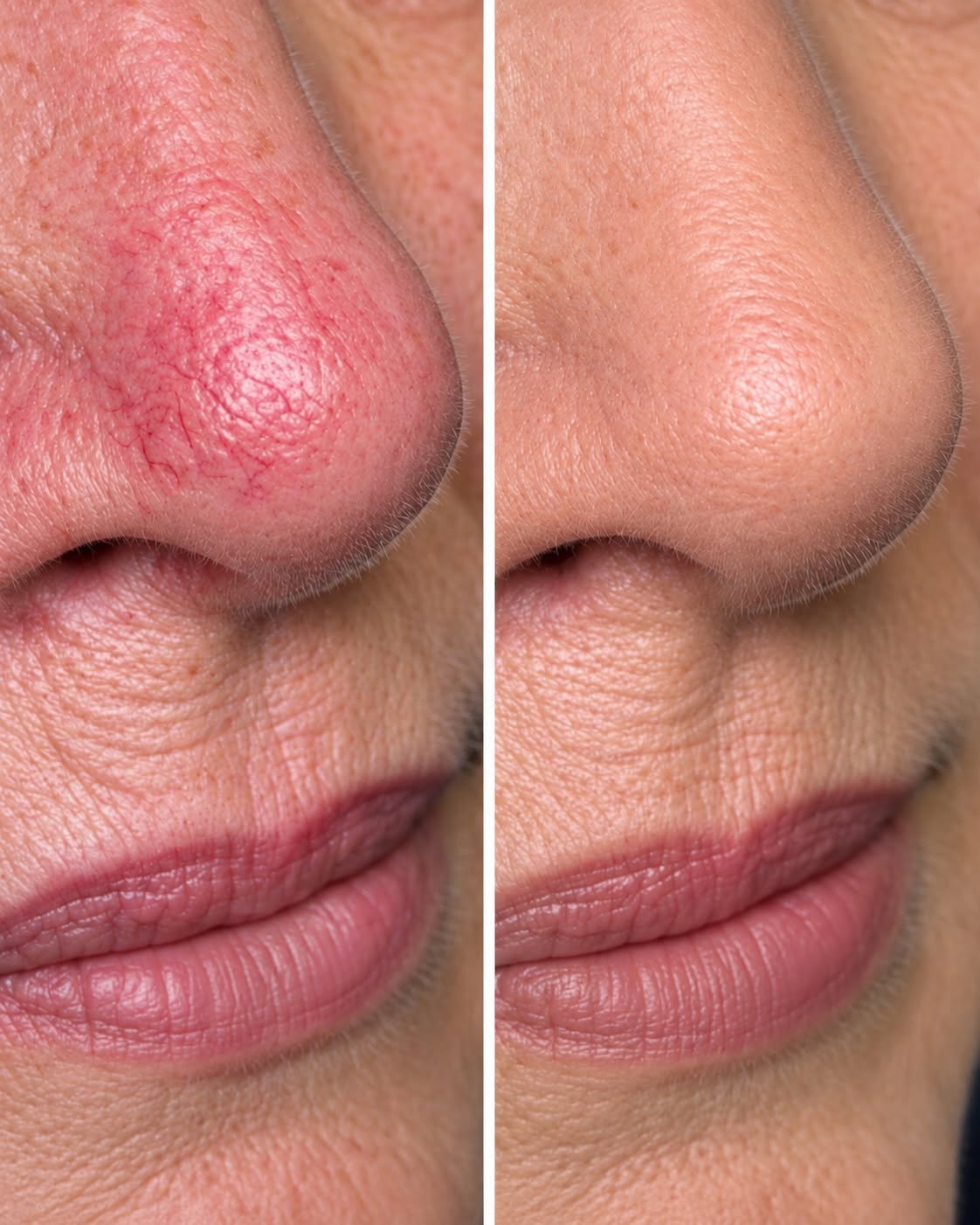
The fine red or pink lines visible around the nostrils may be small superficial blood vessels, sometimes called telangiectasia. These are tiny vessels close to the skin’s surface that have become noticeably visible. They can appear around the nose, on the cheeks, or in other areas of the face.
In some people, the vessels are easy to see because the skin is naturally fair or thin. In others, they become more noticeable with age, sun exposure, repeated flushing, or certain inflammatory skin conditions. The appearance varies: some people see a few delicate lines, while others experience broader patches of redness.
Not every red mark is a visible blood vessel, however. Irritation can cause diffuse redness without clearly defined lines. Dry skin may look pink and rough, while inflamed skin can appear swollen, sensitive, or uneven. Conditions such as rosacea and seborrheic dermatitis can also affect the area around the nose.
This distinction matters because different causes may require different approaches. A moisturizer may help a damaged skin barrier, for example, but it will not necessarily remove an established superficial blood vessel. Similarly, a green color-correcting product may temporarily neutralize visible redness, but it does not treat the condition responsible for it.
Look at the pattern rather than relying on color alone. Are the red areas limited to the creases beside the nostrils? Do they appear after using a new skincare product? Does the redness come and go with heat, exercise, or stress? Is there flaking, itching, burning, or a sensation of tightness?
These details can help you understand what might be happening, although they cannot replace a clinical diagnosis. If redness persists, worsens, or is accompanied by other concerning changes, a dermatologist or other qualified healthcare professional can assess the skin and recommend appropriate treatment.
2. Why Redness Often Appears Around the Nose First
The skin around the nose experiences a surprising amount of daily stress. It is exposed to sunlight, temperature changes, wind, facial cleansers, cosmetics, tissues, and the natural oils produced by the skin. The creases beside the nostrils can also collect sweat, oil, and product residue, making them vulnerable to irritation.
For some people, the area is naturally prone to flushing. Blood vessels expand in response to heat, physical activity, emotional stress, or spicy food. This temporary increase in blood flow can make the nose and cheeks look red. Usually, the color gradually settles after the trigger disappears, although repeated flushing may be associated with longer-lasting redness in susceptible individuals.
Sun exposure is another important factor. Ultraviolet radiation contributes to cumulative skin damage over time and can make visible blood vessels and uneven skin tone more noticeable. People who spend a great deal of time outdoors without adequate protection may find that redness becomes more persistent as the years pass.
Skincare habits can play a role as well. Strong exfoliating acids, abrasive scrubs, fragranced products, and frequent use of irritating treatments may weaken the skin barrier. When the barrier is disrupted, the skin can lose moisture more easily and become more reactive to products and environmental conditions.
The skin may then sting when you apply moisturizer, feel tight after washing, or become red after using products that previously caused no problem. Adding more active ingredients in response can make the cycle worse.
The area around the nose can also be affected by conditions that have little to do with ordinary sensitivity. Rosacea may cause recurring flushing, persistent central facial redness, visible blood vessels, or acne-like bumps. Seborrheic dermatitis may cause redness and flaky skin around the sides of the nose, eyebrows, or scalp. Contact dermatitis can develop when the skin reacts to an ingredient or comes into contact with an irritant.
Because these conditions can look similar, it is unwise to assume that every red nose needs the same treatment. The most useful first step is to observe the pattern and simplify your routine while avoiding known triggers.
3. The Difference Between Temporary Flushing and Persistent Redness
A face that becomes red after a hot shower is not necessarily showing the same problem as a nose that remains red every day.
Temporary flushing usually appears in response to a recognizable trigger. The skin may become warm and pink after exercise, drinking a hot beverage, entering a heated room, or feeling embarrassed. As the body cools and the trigger passes, the color usually fades.
Persistent redness remains visible for longer periods or returns frequently in the same areas. It may be accompanied by visible fine vessels, a burning sensation, or a tendency to flush easily. In some people, it is associated with rosacea, although a healthcare professional must assess the complete picture before making that diagnosis.
Irritation-related redness often develops after a product or environmental exposure. The skin may feel raw, itchy, dry, or tight. A new cleanser, exfoliant, retinoid, fragrance, or cosmetic can be responsible, particularly if several products have recently been introduced.
Flaking around the nostrils may point toward a different problem. Seborrheic dermatitis commonly affects oil-rich areas of the face and can produce redness with white or yellowish flakes. Ordinary dryness can also cause scaling, so appearance alone may not provide a definite answer.
Keeping a simple record can help you recognize patterns. Note when the redness appears, how long it lasts, which products you have used, and whether you notice burning, itching, bumps, or flaking. You do not need to document every minute of your day. A few observations over one or two weeks may be enough to identify a likely trigger.
If the redness is persistent, progressively worsening, painful, or accompanied by eye irritation, seek medical advice. Eye symptoms are particularly important in people who may have rosacea, because the condition can sometimes affect the eyes as well as the skin.
The goal is not to diagnose yourself from a list of sympto