
Part 1
I was balanced on a ladder, pulling soggy leaves from the gutters, when my phone vibrated in my pocket. The morning air carried that strange early-autumn feeling—still warm enough to remember summer, but already smelling like change.
“Morning, Dad.”
The moment I heard Clara’s voice, I frowned.
“You sound worn out.”
She gave a quiet laugh.
“It’s been a long week.”
Behind her, I heard a muffled airport announcement, followed by the rolling thunder of suitcase wheels. I pictured her walking through the terminal with the careful, measured pace she had developed over the last six months. Since her separation from Evan, nothing about her had been casual anymore. Every movement seemed planned. Every choice controlled.
“I’m at the airport,” she said. “They just started boarding an earlier flight, so it’s loud here.”
I climbed down the ladder slowly. At seventy-two, I did not take chances with my footing anymore.
“You always show up too early.”
“I know,” she said. “It helps with the anxiety.”
There was a brief pause.
“I wanted to say thank you for checking on the house while I’m gone.”
“That’s what fathers are for.”
“And for finding someone to mow the lawn.”
“He should be there around one.”
“Perfect.”
Another silence followed. This one felt heavier.
“If you go by today,” she said carefully, “don’t worry if the inside looks bare. I packed most things away before leaving.”
I paused.
“You planning to move while you’re gone?”
She laughed, but it was not a happy laugh.
“No. I just wanted everything neat.”
It sounded odd, but then again, so much had seemed odd since the divorce and the ugly custody battle. Clara had become almost painfully cautious. She locked doors twice. Closed curtains before dark. Filed every receipt. Saved every message. She never said she was scared.
But I knew my daughter.
“You’ll call when you land?”
“I promise.”
“I love you.”
“I love you too, Dad.”
The call ended.
At that moment, I had no idea that it would be the last normal conversation we would have that day.
Around noon, I drove to Clara’s house to water her flowers before going back home to finish my own yard work. Everything looked exactly as it should. The white shutters were closed against the afternoon heat. The porch was clean. No packages sat by the door. Nothing seemed broken, disturbed, or out of place.
I checked the mailbox, watered the hanging baskets, and locked the gate the way Clara always asked me to.
As I drove away, a dark pickup truck turned out of the neighborhood. Its windows were too tinted for me to see the driver. I barely noticed it.
Later, I would wish I had.
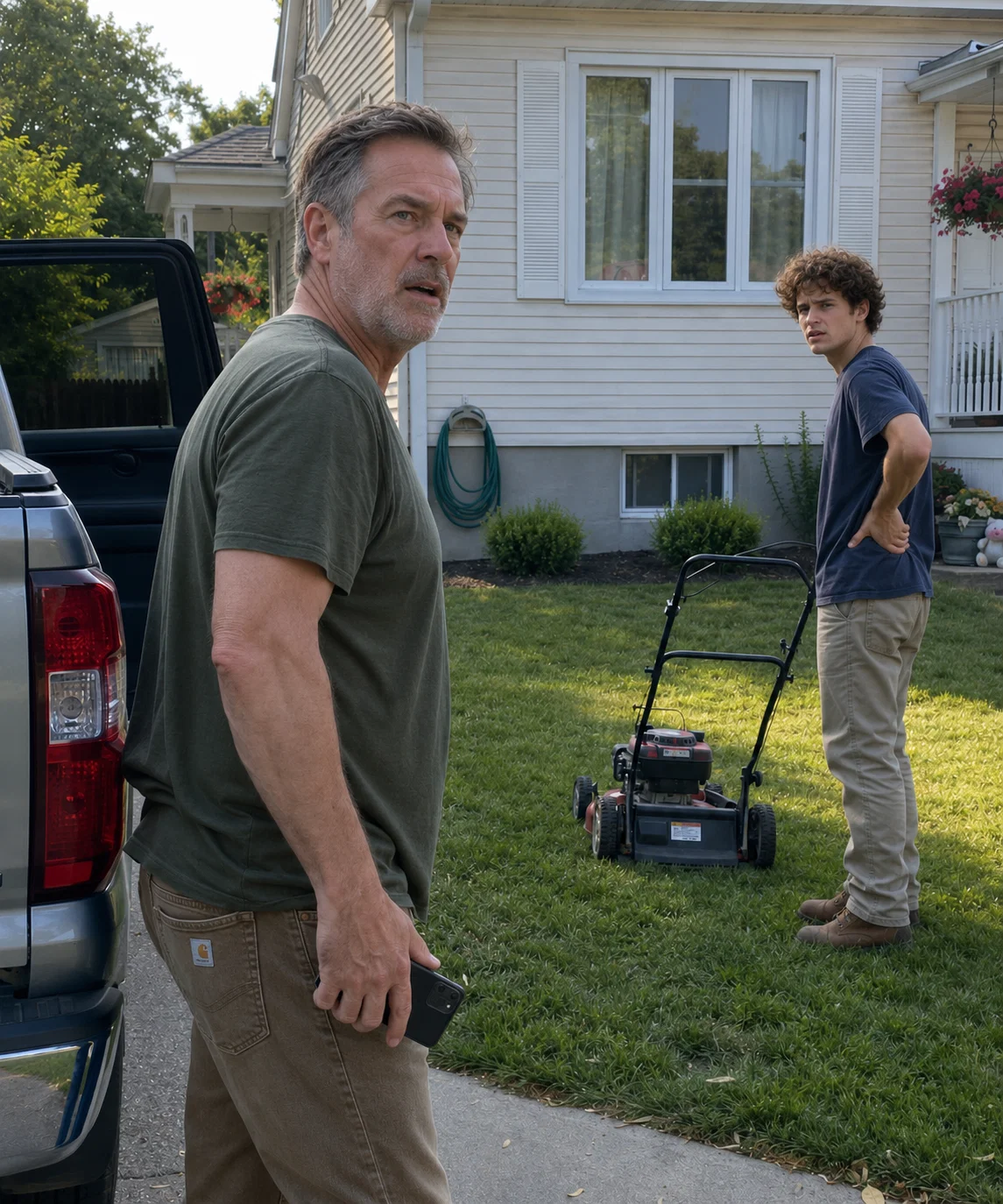
At 1:15 p.m., Jesse, the young man I had hired to mow the lawn, sent me a photo of the front yard. The grass looked clean and even.
Looks good so far, he wrote. Starting the backyard now.
I sent back a thumbs-up and returned to cleaning out my garage. I was sorting old tools and moving boxes, doing the kind of work that keeps your hands busy while your mind wanders.
About forty-five minutes later, my phone rang.
Jesse’s voice was different this time—lower, careful, uncertain.
“Mr. Whitmore?”
“Everything okay?”
“I’m not sure.”
I set down the rake in my hand.
“What happened?”
“I keep hearing someone crying.”
My chest tightened.
“Where?”
“Inside your daughter’s house.”
For a second, I did not answer.
“That can’t be right.”
“I thought it was coming from another yard,” he said quickly, like he was embarrassed. “But whenever I turn off the mower, it sounds like it’s coming from inside.”
Then I heard the mower stop in the background.
Part 2
Silence.
And then, faintly, a child cried.
Not loudly. Not desperately. Just a small, tired sob that disappeared almost as soon as it came.
Jesse whispered, “That’s what I’ve been hearing.”
The house was supposed to be empty.
“I was there this morning,” I said.
“I haven’t gone in,” Jesse answered. “I just thought… if someone needed help…”
“You did the right thing.”
I was already reaching for my keys.
“Stay outside. I’m coming.”
I called Clara first. It went straight to voicemail. That made sense if she was on the plane, but it still made my stomach twist.
“Call me as soon as you hear this,” I said.
Then I called Evan.
No answer.
The divorce had been finalized almost a year earlier, but the fight over their two-year-old son, Liam, had dragged on and on. Hearings. Lawyers. Evaluations. Accusations. Clara and Evan barely spoke directly anymore. Everything went through attorneys or written messages, carefully worded so nothing could be twisted later.
As I pulled out of my driveway, I remembered something from three weeks earlier.
Clara had come over for dinner and barely touched her food. Halfway through the meal, she asked me a strange question.
“Dad, if someone kept driving past your house without stopping, would you think that was weird?”
I had put my fork down.
“Is someone doing that?”
She forced a smile.
“It’s probably nothing.”
I had not believed her.
And now, driving toward her house, I hated myself for not pressing harder.
It took me fifteen minutes to get there. Jesse was waiting beside his mower, looking relieved the moment he saw me.
“I’m glad you’re here.”
“You stayed outside?”
“Yes, sir.”
He pointed toward the backyard.
“It comes and goes.”
As if on command, another faint cry drifted through the afternoon air. My arms prickled.
“I hear it,” I said.
Jesse exhaled.
“I thought I was imagining it.”
“You weren’t.”
We walked around the side of the house. Nothing looked forced. No broken windows. No damaged locks. No muddy footprints in the flowerbeds. The backyard looked almost exactly the way it had when I left.
Almost.
Near the back steps, a grocery bag had fallen over. A box of crackers lay in the grass beside a receipt. I picked it up and read the timestamp.
Less than two hours earlier.
Chicken noodle soup. Bananas. Apple juice. Children’s fever medicine. Diapers. Electrolyte drinks.
Someone had gone shopping for a sick toddler.
I looked at Jesse.
“I didn’t see anyone come back,” he said.
The back door was closed, but it had not latched all the way.
That was not like Clara.
Since the custody fight had turned ugly, she had become almost obsessive about safety. New locks. Checked windows. Alarm questions. Closed doors. Locked gates. All the habits of a woman who no longer felt secure in her own home.
I reached beneath the ceramic frog near the flowerpot. The spare key was still there.
Jesse shifted beside me.
“Maybe we should call the police first.”
He was probably right.
But then the crying came again. Softer this time. Weaker.
The unmistakable sound of a little boy trying not to cry.
Every instinct I had as a father and grandfather overruled everything else.
“If a child is in there,” I said, “I’m not waiting outside.”
The kitchen smelled faintly of soup. A saucepan sat on the stove, the contents cooled and thick. A child’s cup rested beside the sink, washed and drying. The room was tidy, but not empty.
Someone had been there.
Someone had been living there that day.
Jesse stayed near the doorway.
“I’ll wait here.”
I nodded and moved deeper into the house.
The cry came again.
Then a woman whispered gently, “It’s okay, sweetheart.”
My heart hammered.
At the end of the hallway, the basement door stood slightly open.
Clara hated open doors. She always had. Cabinets, closets, bedrooms—everything closed, everything orderly. She said it made the house feel calm.
This door being open felt wrong.
I pushed it wider.
Cool air rose from below.
The whispering stopped.
So did the crying.
“Hello?” I called.
No answer.
Only the faint creak of someone shifting in the basement.
Jesse lowered his voice behind me.
“Mr. Whitmore… maybe we should wait.”
But if Liam was down there, I could not wait.
I started down the stairs.
Halfway down, I saw a small blanket folded on the landing. Yellow ducks covered the fabric. My late wife had sewn that blanket before Clara was even born. I still remembered her sitting by the window, stitching each tiny duck with careful hands and a smile she could not hide.
That blanket belonged in the cedar chest upstairs.
Seeing it there made no sense.
At the bottom of the stairs, the basement opened in front of me.
And for a moment, I could not breathe.
The unfinished basement had been turned into a hidden little apartment.
A mattress sat in one corner. Children’s books were stacked on a low shelf. Plastic bins held neatly folded toddler clothes. There were diapers, bottled water, canned food, medicine, toys, and a folding table covered with legal papers.
Nothing looked careless.
Nothing looked rushed.
Someone had planned this.
Then I heard a tiny cough.
I turned.
A little boy sat on the mattress, clutching a worn stuffed rabbit. His cheeks were flushed, and his eyes were wet with feverish tears.
“Mommy…”
A woman stepped from the shadows, lifted him into her arms, and kissed his hair.
Then she looked at me.
“Dad.”
Clara looked exhausted. Her hair was tied back loosely. Dark circles sat beneath her eyes. She wore the same sweater she had worn during our phone call from the airport.
She did not look shocked to see me.
She looked relieved.
Behind me, Jesse quietly stepped away.
“I’ll give you some privacy,” he said.
Neither Clara nor I answered.
I stared at my daughter.
“You never left,” I whispered.
She held Liam tighter.
“No,” she said. “I couldn’t.”
For a long moment, the only sound was the quiet hum of a small fan and Liam’s uneven breathing against her shoulder.
“I’m sorry, Dad,” Clara said softly. “I didn’t want you to find out like this.”
I looked around again. Water. Medicine. Blankets. Food. Documents. Every detail had been arranged with care.
This was not a hiding place made in panic.
It was a refuge.
Part 3:
“Why?” I asked.
She took a slow breath.
“I really did go to the airport.”
“I believe you.”
“I checked in. I sat at the gate.”
“So why did you come back?”
She looked down at Liam.
“Because I couldn’t leave him.”
“You were only going away for a few days.”
“I know.”
Her eyes filled with tears.
“But every announcement made me feel farther away from him. When they called my boarding group, I stood up… and I couldn’t walk through the gate.”
“So you came home.”
She nodded.
“I called you from the airport before I left. I knew if I sounded uncertain, you’d start asking questions.”
That explained the noises in the background. The rolling suitcases. The announcement. She had not lied about being at the airport.
She had lied about boarding the plane.
“I almost called you when I got back,” she admitted. “Three times.”
“Why didn’t you?”
“Because I know you.”
She gave me a tired smile.
“The second you knew I was here, you would have driven over.”
She was right.
“And I was afraid you’d confront Evan,” she added.
“I probably would have.”
“And then his lawyer would say my family was interfering before Monday’s emergency hearing.”
I looked at the stack of files on the table.
“What happens Monday?”
“My attorney filed an emergency request to suspend Evan’s visitation.”
“Based on what?”
She handed me a thick folder.
Inside were police reports, legal letters, photos, printed messages, and a statement Clara had written in calm, precise language. One photo showed marks on Liam’s upper arm. Another report described Evan returning him hours late after a scheduled visit.
I looked up.
“He threatened you.”
Clara nodded.
“The last time he dropped Liam off, he smiled and said, ‘One day I won’t bring him back, and you’ll never see him again.’”
Cold anger moved through me.
“You reported it?”
“Immediately.”
“What did they say?”
“No witnesses. My word against his.”
Then I remembered the truck.
“The dark pickup.”
Her face changed.
“You saw it?”
“I saw one leaving the neighborhood today.”
“It wasn’t the first time,” she said. “He’s been driving past the house.”
She pointed toward the small basement window.
“I covered the window at night so no one could see light down here.”
Now I understood.
“The upstairs looked empty.”
“That was the point,” she said. “If Evan drove by, I wanted him to think I’d actually gone to Phoenix.”
“Why stay here at all?”
“My lawyer told me not to leave my legal residence unless there was an immediate emergency. If I took Liam somewhere else, Evan’s attorney could claim I was violating the temporary custody arrangement.”
“So you stayed where the court expected you to be.”
She nodded.
“I just had to make it through the weekend.”
Outside, Jesse’s mower started again. The sound was so ordinary that it almost felt cruel.
Then Liam stirred and opened his eyes. He looked at me and reached out one small hand.
“Grandpa.”
I smiled.
“Hey, buddy.”
He lifted his stuffed rabbit.
see you next post
