Step Back From the Image
If you’re staring at the illustration on a phone, zoom out for a moment.
ADVERTISEMENT
A face that seems invisible up close may suddenly become apparent when you view the entire picture.
Then zoom back in.
It’s almost like your eyes need to change gears.
Don’t Let the Obvious Faces Stop You
This is probably the biggest mistake people make.
They find one or two faces and assume they’ve solved the puzzle.
But hidden-face illustrations are designed to reward persistence.
ADVERTISEMENT
Once you’ve found the obvious shapes, keep looking.
Ask yourself:
Commission Custom Prints
Could that branch actually be part of a face?
Is that shadow an eye?
Does that curve create a cheek or jawline?
Do two separate shapes combine to form a portrait?
You may be surprised by how many details suddenly start looking different.
Why Your Brain Sees Faces Everywhere
Have you ever looked at a cloud and thought it looked like an animal?
Or noticed a face in the pattern of wood grain?
Maybe you’ve seen a smiling face in the front of a car.
That’s pareidolia at work.
Our visual systems are constantly searching for meaningful patterns.
Faces are particularly important patterns for humans to recognize, so our brains can be remarkably quick to detect something that resembles one—even when the image is completely accidental.
That’s why a tree illustration filled with hidden faces can be so effective.
Your brain is essentially playing along with the artist.
Is This an Intelligence Test?
Not really.
That’s another reason not to take the puzzle too seriously.
Finding hidden faces isn’t a reliable measure of intelligence.
Someone might spot several faces immediately because they’re familiar with this type of puzzle or because their visual attention happens to suit the task.
Access Writing Tools
Discover more
Get Study Guides
Order Custom Logos
Trees
Another person might need several minutes.
Neither result tells you how intelligent that person is.
These puzzles are better understood as observation challenges.
They’re designed to make you look carefully and notice details you might normally overlook.
And honestly, that’s enough.
Why Optical Illusions Are So Addictive
There’s something incredibly satisfying about finally seeing something you’ve been searching for.
At first:
“I don’t see anything!”
Then:
“Wait… there!”
And once you see it, you can’t unsee it.
That little moment of discovery is what keeps people sharing optical illusions with friends and family.
It’s also why these puzzles make such fun conversation starters.
Send the image to someone and ask:
“How many faces can you find?”
Just don’t give away the locations immediately!
Try the Puzzle With Someone Else
Here’s a fun idea.
Show the illustration to a friend without explaining where the faces are.
Give them a time limit—perhaps two or three minutes.
Ask them to write down their count.
Then compare answers.
You may discover that you both noticed completely different faces.
That’s part of what makes visual puzzles interesting.
Two people can look at the exact same image and direct their attention toward completely different details.
What Makes the National Leaders Tree Different?
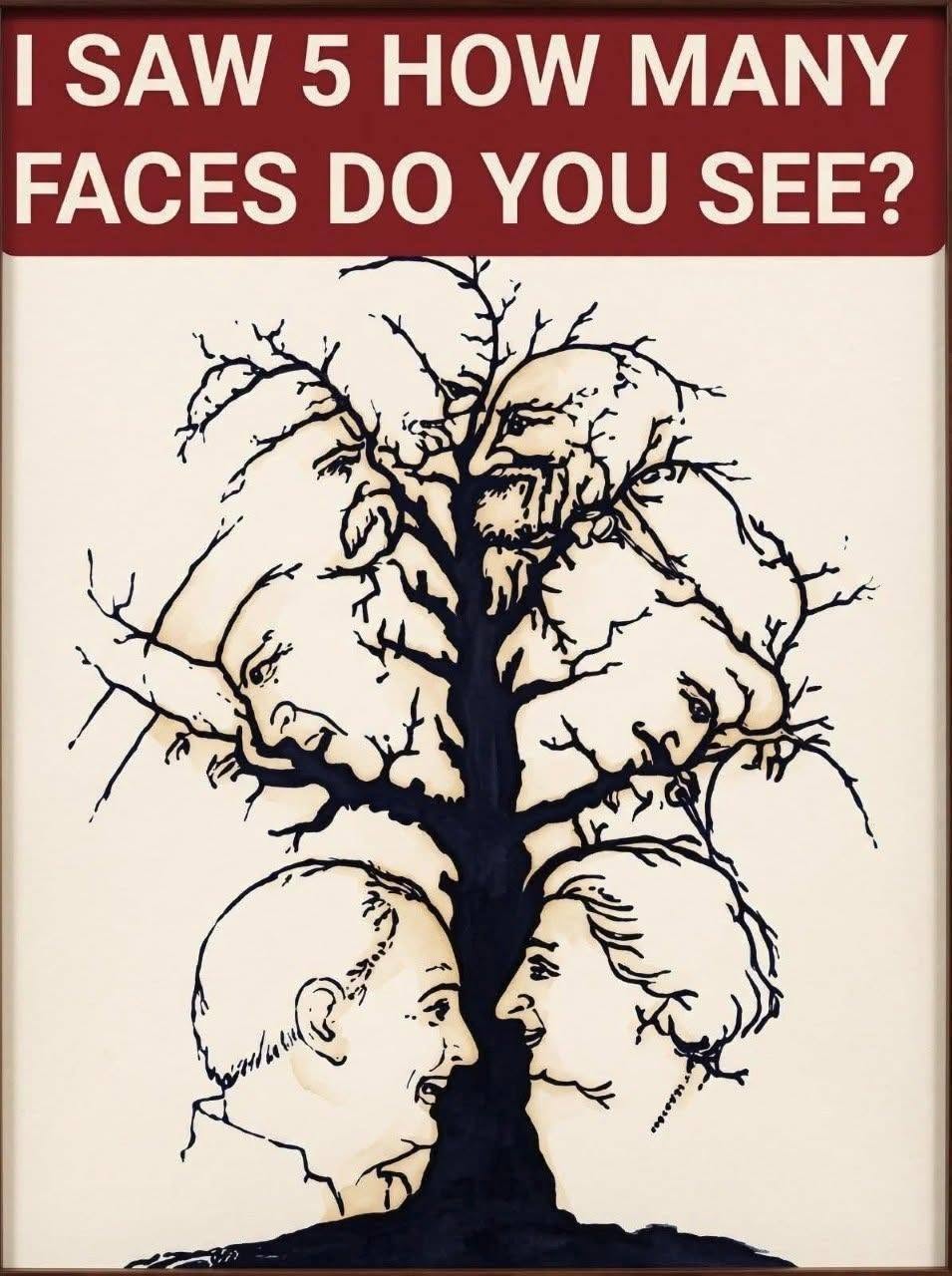
The appeal of the National Leaders Tree comes from the way the artwork combines a familiar natural object with recognizable human forms.
A tree is easy for the brain to identify at a glance.
The hidden faces require a second level of attention.
That contrast creates the puzzle.
You’re not trying to identify an unfamiliar object.
You’re trying to discover familiar objects hiding inside something familiar.
t’s almost like the artist is asking:
“How closely are you really looking?”
The Hidden-Face Challenge
Before looking for answers or having someone point them out, give yourself a fair chance.
Spend a few minutes with the illustration.
Try these three approaches:
Look at the whole tree.
Break it into smaller sections.
Look for individual facial features instead of complete faces.
And don’t forget to step back from the image occasionally.
Your brain may recognize a pattern at a different viewing distance.
How Many Faces Did You Find?
Now comes the fun part.
How many did you spot?
If you immediately found several, congratulations—you have some seriously attentive eyes!
If you found only one or two, don’t worry.
These puzzles are intentionally designed to make certain shapes difficult to recognize.
And if you eventually need someone to point out the hidden faces?
That’s perfectly fine too.
Sometimes the best part isn’t solving the puzzle.
It’s the moment when someone finally says:
“Look right there!”
And you suddenly realize the face was practically staring back at you.
Frequently Asked Questions
What is the National Leaders Tree?
The National Leaders Tree is a visual puzzle illustration in which human faces are incorporated into the shape and details of a tree. Viewers are challenged to locate and count the hidden faces.
Is there a correct number of faces?
The exact count should be based on the specific version of the illustration being viewed. Different reproductions or interpretations can make some shapes more or less recognizable.
Why do I see faces in the tree?
Your brain naturally looks for familiar patterns, particularly faces. This tendency is called pareidolia and helps explain why people can perceive faces in objects that aren’t actually faces.
Are hidden-face puzzles good for your brain?
They can be a fun way to practice careful observation and visual attention, but they shouldn’t be treated as a scientific intelligence test.
Why can’t I find all the faces?
Some faces are deliberately integrated into larger shapes and may only become apparent when you change your focus, viewing distance, or the part of the image you’re examining.
Does finding the faces quickly mean I’m smarter?
No. Puzzle performance depends on many factors, including familiarity with visual puzzles, attention, experience, and how an individual interprets patterns.
What’s the best way to solve a hidden-face puzzle?
Take your time, divide the image into sections, look for individual facial features, examine negative space, and occasionally step back to view the entire image.
Final Thoughts
The National Leaders Tree is a perfect example of why simple-looking pictures can be surprisingly difficult to understand.
At first glance, it’s just a tree.
Look closer, though, and the entire illustration starts to change.
Branches become facial outlines.
Shadows become eyes.
Curves become noses and cheeks.
And suddenly you’re no longer looking at a tree in quite the same way.
That’s the magic of a good optical illusion.
It doesn’t necessarily change the picture.
It changes the way you see it.
So take another look before you scroll away.
How many faces can you spot?
And more importantly…
How many did you completely miss the first time?
Did You Spot Them All?
If this puzzle made you stop and stare, share it with someone who loves brain teasers and optical illusions.
Ask them how many faces they can find before giving away any clues.
And if you discover a hidden face that you think everyone else is missing, let us know!
Share your favorite puzzles on Pinterest, save this one for later, and challenge your friends to see who has the sharpest eyes.
Because sometimes the most interesting things aren’t hidden very far away.
They’re hiding right in front of us.