Why Are Hidden Faces So Easy to Miss?
Our brains are remarkably good at recognizing familiar patterns.
A human face is one of those patterns we are especially sensitive to.
That’s why we can sometimes see a face in a cloud, a rock formation, a shadow, or even the front of a car.
This tendency is known as pareidolia—the perception of a recognizable image or pattern, particularly a face, in something that doesn’t actually contain one.
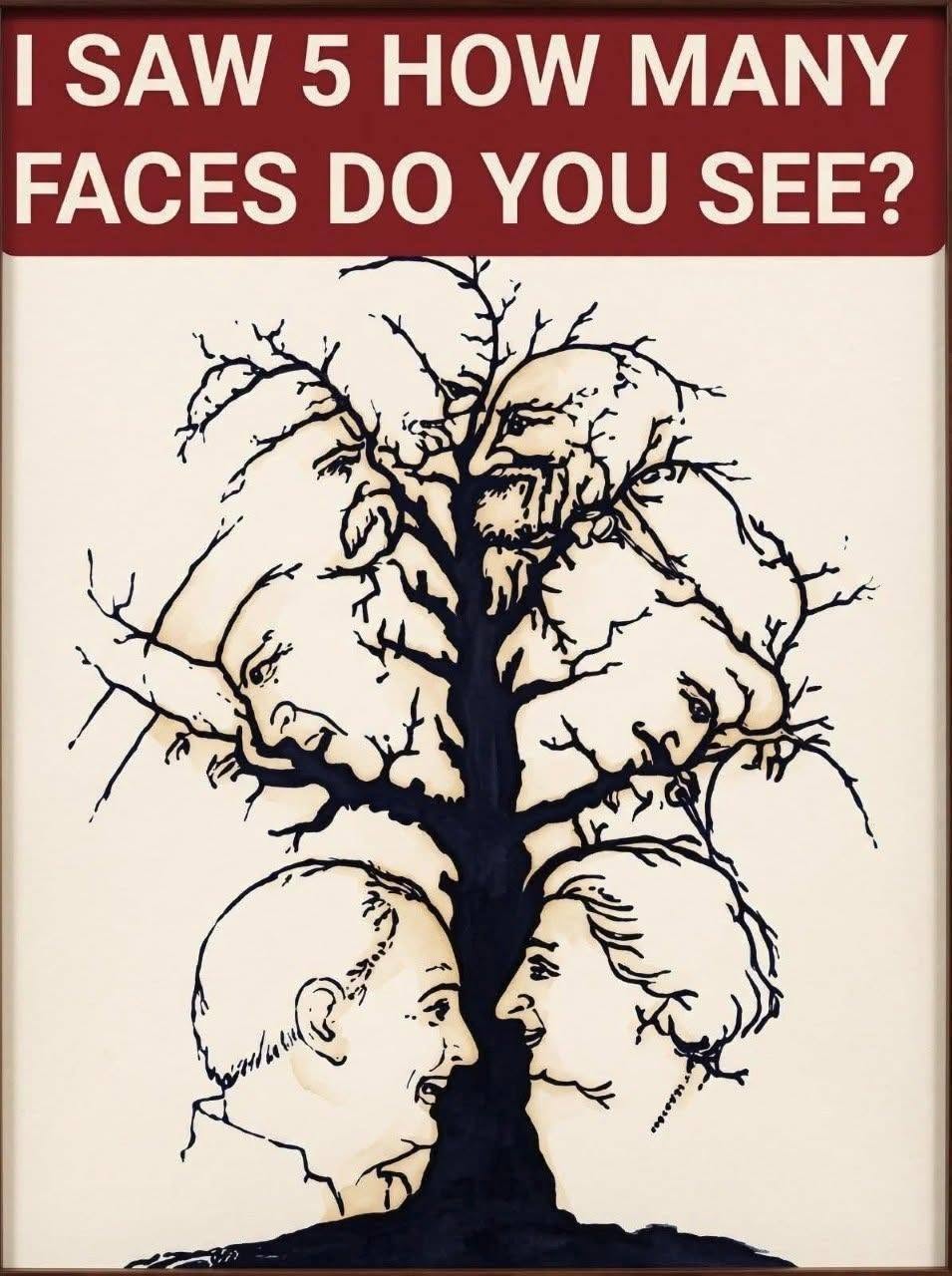
The National Leaders Tree takes advantage of that fascinating feature of human perception.
Instead of presenting faces separately, the artwork blends facial shapes into the larger picture.
Your brain has to switch between seeing a tree and seeing individual faces hidden within the tree.
That’s easier said than done!
The First Impression Can Fool You
When you first look at the illustration, your brain tends to process the image as a whole.
You see a tree.
That’s the dominant object.
Because your attention is focused on recognizing the overall scene, smaller shapes can slip past without being consciously noticed.
This is one reason visual puzzles are so entertaining.
The information was right there in front of you.
You simply weren’t looking for it yet.
Then someone points out one hidden face and suddenly you can’t stop seeing it.
How to Search for the Faces
Want to give yourself the best chance of finding them?
Try changing the way you examine the image.
Start With the Trunk
Don’t immediately jump toward the outer branches.
Study the trunk carefully.
Look for shapes that resemble:
Eyes
Noses
Mouths
Hairlines
Facial outlines
Sometimes the easiest way to recognize a hidden face is not to look for a complete portrait.
Look for parts of a face first.
Move Slowly Through the Branches
Next, work your way upward.
Instead of scanning the entire tree at once, divide it into sections.
Look at the left side.
Then the center.
Then the right.
This prevents your eyes from repeatedly jumping toward the most obvious details.
Turn Your Attention to Negative Space
Here’s a trick that can help.
Don’t just examine the dark shapes.
Look at the spaces between the branches.
Sometimes a face is created by the outline of surrounding objects rather than by a clearly drawn portrait.
That’s where these puzzles can become wonderfully sneaky.
For Complete Cooking STEPS Please Head On Over To Next Page Or Open button (>) and don’t forget to SHARE with your Facebook friends