The file lay open at my feet like something alive.
For a few seconds, I couldn’t move.
The hallway around us seemed to stretch impossibly long. Nurses moved past with medication carts. A man coughed behind a half-closed door. Somewhere nearby, a machine released a steady, patient beep.
But all I could see was the date printed on the first page.
It was from six weeks before our divorce was finalized.
Six weeks before I signed my name beneath the words that ended our marriage.
Six weeks before I told myself Sophie and I had already lost everything worth fighting for.
My hands felt numb as I bent down and picked up the file. The papers shifted in my grip, covered in medical terms I didn’t immediately understand. But a few words stood out clearly enough to make the floor seem to tilt beneath me.
Further evaluation required.
Urgent referral.
Abnormal growth.
I looked up at Sophie.
She had gone pale.
“Sophie,” I whispered, “what is this?”
The doctor stepped closer, his face serious but not unkind. He was a tall man in his late forties with tired eyes and a badge that read Dr. Raymond Keller.
“Sophie,” he said gently, “I think he deserves an explanation.”
She stared at him as if those words had hurt her.
Then she looked at me.
For the first time since I’d seen her in that hallway, there was something other than sadness in her eyes.
Fear.
“I didn’t want you to know like this,” she said.
My throat tightened.
“Know what?”
She pressed one hand against the IV stand, steadying herself. She looked so fragile that instinctively I stepped forward, but she lifted her other hand, stopping me.
That tiny motion cut deeper than any accusation could have.
“After the last miscarriage,” she said slowly, “the doctors found something.”
I looked down at the file again, even though the words were blurring.
“What kind of something?”
“A tumor.”
The word landed with a weight I wasn’t ready for.
I heard it, understood it, and still my mind refused to accept it.
“A tumor,” I repeated, because it was the only thing I could say.
Dr. Keller’s expression softened. “It was discovered during follow-up testing after the pregnancy loss. At first, we needed more imaging to understand what we were dealing with.”
I stared at Sophie.
“You knew before the divorce?”
She flinched.
That was my answer.
A cold, hollow ache opened in my chest.
“You knew,” I said again, quieter this time.
Sophie lowered her eyes.
“I found out around the time you asked me for the divorce.”
“No,” I said, shaking my head. “No, that doesn’t make sense. Why didn’t you tell me?”
Her lips parted, but no words came.
I turned to Dr. Keller, desperate for someone to say there had been a misunderstanding. That the dates were wrong. That this file belonged to someone else. That my wife—my ex-wife—had not been carrying this alone while I was busy convincing myself that leaving her was a kindness.
But the doctor didn’t rescue me from the truth.
“Sophie asked that her medical information remain private,” he said carefully. “That was her right.”
I looked back at her.
“Private from me?”
Her eyes filled with tears, but she didn’t let them fall.
“We were already breaking, Ethan.”
“That’s not an answer.”
“It’s the only one I had.”
My voice came out sharper than I intended. “You were sick, Sophie. You were scared. You were going through this, and you let me walk away?”
Her face changed then.
Not with anger exactly.
With exhaustion.
“I didn’t let you do anything,” she said. “You chose to leave.”
The words struck with quiet precision.
I had no defense against them.
Because she was right.
I had chosen.
I had told myself I was ending our suffering. I had told myself that some damage couldn’t be repaired. I had told myself divorce would be cleaner than living in a house filled with grief.
But standing in that hospital hallway, holding medical papers that proved Sophie had been battling something far worse than I imagined, every excuse I’d used to survive the past two months collapsed.
Dr. Keller cleared his throat softly.
“Sophie needs to return to her room,” he said. “She had a procedure this morning. She shouldn’t be standing this long.”
“What kind of procedure?” I asked.
Sophie’s gaze dropped again.
Dr. Keller looked at her, waiting for permission.
After a long moment, she gave the smallest nod.
“A biopsy,” he said. “And additional imaging. We’re monitoring a few complications, but she’s stable.”
Stable.
That word should have comforted me. Instead, it felt terrifyingly thin.
“Is it cancer?” I asked.
Sophie closed her eyes.
Dr. Keller didn’t answer right away, and that pause told me enough.
“We don’t have final pathology yet,” he said. “Some findings are concerning. We’re waiting on results.”
I felt as if someone had reached into my chest and gripped my heart.
I turned back to Sophie.
“How long have you been coming here alone?”
She swallowed.
“Since January.”
January.
Months.
Not weeks.
Months.
I thought of all the evenings I’d stayed late at the office. All the texts from her that I answered with one-word replies. All the nights she sat across from me at dinner, quieter than usual, while I assumed she was simply lost in the same grief that had swallowed us both.
I thought of the day she packed her clothes.
How calmly she folded each sweater.
How she paused at the bedroom door and looked around as if memorizing the place.
I had thought she was accepting the end of us.
Now I wondered if she had been saying goodbye to more than our marriage.
“Sophie,” I said, my voice breaking, “why would you go through this alone?”
She gave a tired smile that didn’t reach her eyes.
“I wasn’t alone.”
I glanced around the empty hallway.
She understood what I was thinking.
“My mother came when she could,” she said. “A neighbor drove me after one appointment. Sometimes I took rideshares. It was manageable.”
Manageable.
I hated that word.
I hated the picture it created: Sophie sitting in the back seat of a stranger’s car after tests that could change her life, holding herself together because she had decided I was no longer someone she could call.
Dr. Keller took the file gently from my hand and returned it to Sophie’s bedside chart.
“We should continue this conversation inside,” he said.
Sophie didn’t move.
Neither did I.
The space between us felt full of ghosts.
Finally, she looked at the doctor. “Can we have a minute?”
He hesitated, then nodded. “One minute. Then you need to rest.”
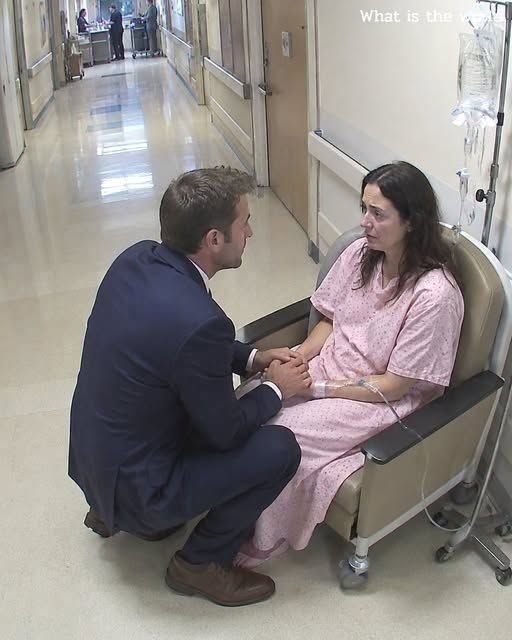
When he disappeared into the room, Sophie sank back into the chair by the window. The movement looked painful, though she tried to hide it.
I crouched in front of her before thinking better of it.
Once, I would have taken her hand without hesitation.
Now I didn’t know if I had the right.