
Humans are naturally pattern-seeking. It is a survival-based cognitive trait that helps us interpret the world quickly, but it also leads to over-interpretation.
4. Familiarity Surprise
The more familiar something is, the more surprising it feels when we are told there is something new to see in it.
These psychological effects combine to create the perfect environment for viral “hidden detail” content.
Do Designers Actually Hide Secrets in Logos?
In professional branding design, companies sometimes include subtle elements in logos—but these are usually intentional, strategic, and clearly documented by designers.
For example, some brands embed symbolism to represent speed, unity, direction, or heritage. However, these design choices are typically part of official branding explanations and are not meant to be secret discoveries.
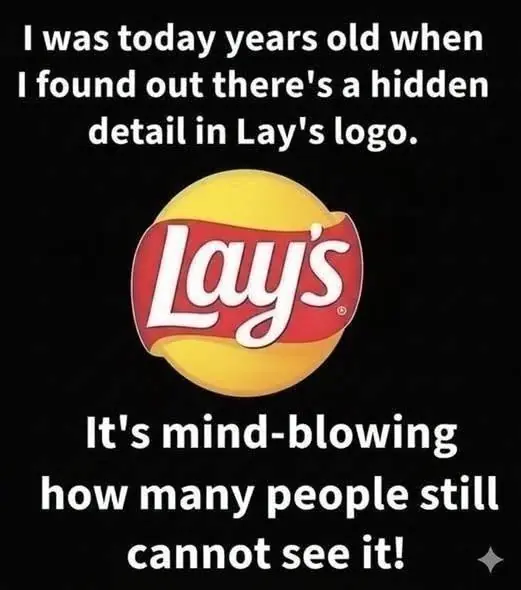
In the case of Lay’s, there is no widely confirmed or officially stated hidden symbol in the logo that matches the viral claims circulating online.
What exists instead is a strong, effective design that is open to interpretation.
Because the logo is simple and uses bold shapes, it naturally invites people to project meaning onto it. That does not make the interpretations real in a factual sense, but it does make them psychologically interesting.
Why Lay’s Logo Works So Well Without Hidden Features
Even without any secret elements, the Lay’s logo is highly effective for branding reasons:
The yellow sunburst suggests warmth, freshness, and energy
The red ribbon draws attention and creates contrast
The white lettering ensures readability
The circular composition makes it feel complete and balanced
These are classic design principles used in many successful consumer brands. The goal is not to hide messages, but to create instant recognition and positive emotional association.
Ironically, the simplicity that makes the logo effective is also what allows viral interpretations to emerge.
How Viral Misinterpretations Spread So Quickly
Social media platforms amplify content that triggers engagement, and “you’ve never noticed this before” posts are extremely effective at generating clicks, comments, and shares.
Once a claim like this starts circulating, it often evolves:
Someone posts a “discovery”
Others repost it with slight variations
The claim becomes exaggerated over time
People begin debating what they see
The original context becomes less important than the conversation
By the time the post reaches a wide audience, it often feels like a widely accepted fact, even if it began as an interpretation or exaggeration.
The Experience of “Seeing It” Yourself
Part of the appeal of posts like this is the moment of personal discovery. Even when people know intellectually that there is no confirmed hidden feature, they still look closely at the logo, trying to see what others are talking about.
Sometimes they convince themselves they see something new. Sometimes they don’t see anything unusual at all but still understand why others might interpret it differently.
That shared experience—of looking, questioning, and discussing—is what keeps the trend alive.
A Reminder About Viral “Hidden Details”
The Lay’s logo example is just one of many viral posts that claim hidden meanings in familiar designs. These kinds of stories often fall into a broader category of internet content where curiosity and interpretation blend together.
While it can be fun to explore these ideas, it is also important to recognize the difference between:
Actual design intent (confirmed by creators)
Visual interpretation (what people perceive)
Viral exaggeration (what spreads online)
Understanding that difference helps make sense of why so many “hidden detail” posts feel surprising, even when nothing has actually changed.
Final Thoughts
The viral claim about a hidden detail in the Lay’s logo is a great example of how modern internet culture turns familiar objects into moments of rediscovery. While there is no verified secret element hidden in the design, the conversation itself reveals something more interesting: how easily human perception can be influenced by suggestion, curiosity, and repetition.
In the end, the logo remains what it has always been—a simple, bold, and effective piece of branding. The “hidden detail,” if anything, exists more in the way we see it than in the design itself.
And perhaps that is why posts like this continue to spread: not because the object changes, but because our attention to it does.
