
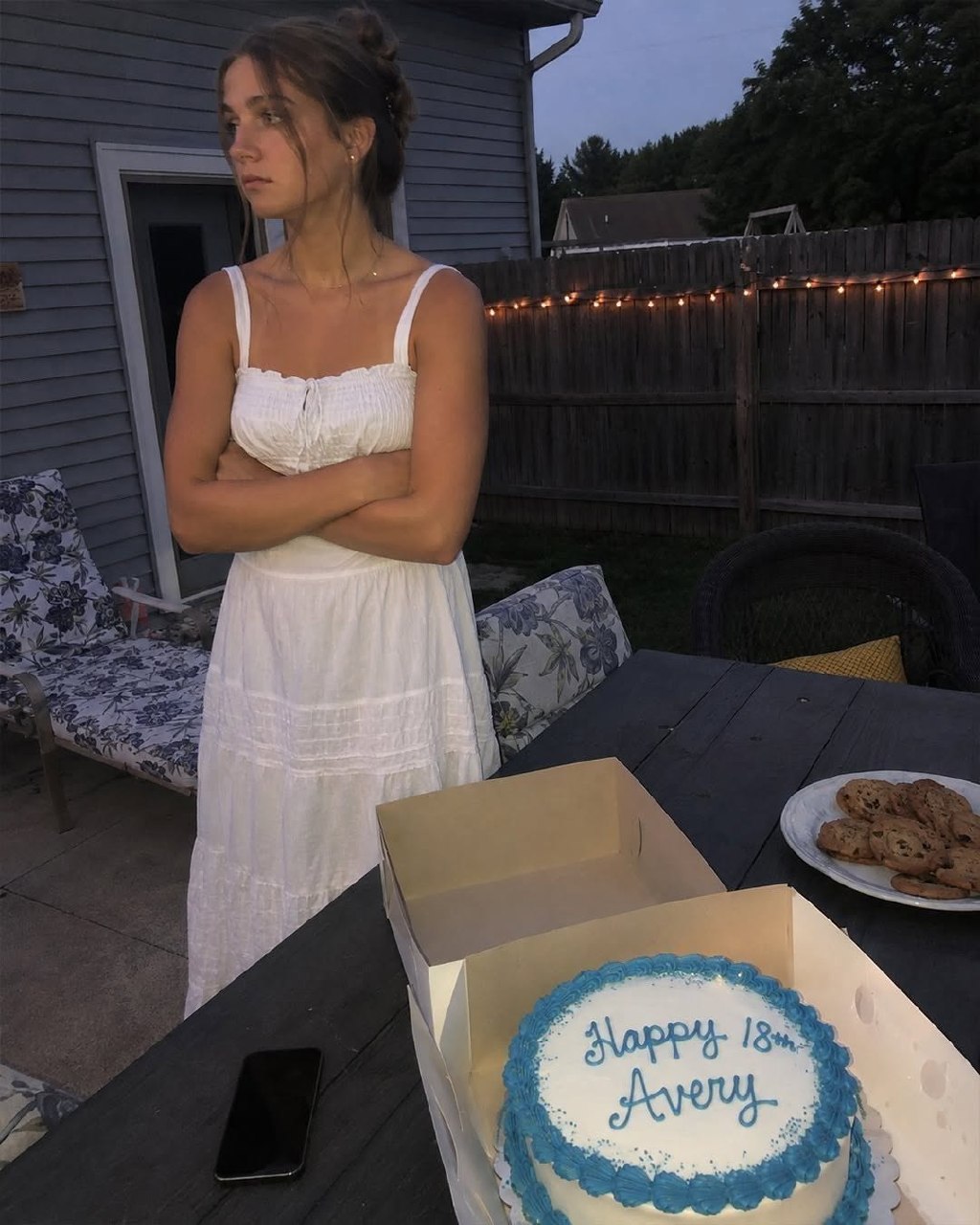
For the first time in eighteen years, my chest did not feel tight.
“Hungry?” Edward asked as we turned onto the main road.
“Yes,” I said. “I haven’t eaten all day.”
“There’s a diner ten minutes up. We’ll get you a burger and a slice of cake. A real one.”
I leaned my head back and watched the streetlights pass.
I was leaving.
I was really leaving.
And I knew I was never going back.
The first morning at Edward’s house did not feel real.
I woke at seven out of habit, muscles tense, waiting for the sounds that had shaped my life. My father rushing for his keys. Miranda complaining that something was wrong. My mother yelling my name from downstairs.
Avery, the coffee maker isn’t working.
Avery, where’s the iron?
Avery, can you handle this?
I waited.
Nothing came.
Only wind moving through pine trees outside the window.
The guest room had wooden beams across the ceiling, a simple dresser, a small desk, and a quilt that smelled like lavender and cedar.
It did not feel like a room for someone useful.
It felt like a room for someone welcome.
In the kitchen, I found breakfast on the counter under a paper towel.
Two fried eggs. Bacon. Buttered toast.
I stared at the plate until my eyes burned.
It sounds strange to cry over toast, but no one had cooked breakfast for me in years. Since I was twelve, I had been the one cooking.
No one had paused to wonder if Avery might be hungry.
I sat at the table and ate slowly.
My phone kept lighting up.
Fourteen missed calls from Mom.
Eight from Dad.
Three from Miranda.
Dozens of texts.
Mom: Avery, this isn’t funny.
Mom: We are your parents. You can’t just walk out.
Mom: Miranda is crying. You ruined her night. Are you happy?
Dad: Pick up the phone. We need to discuss rules if you’re going to live there.
Dad: Grandpa is too old to take care of you. Don’t be selfish.
Miranda: I need a ride to campus. Mom won’t drive me. Where are you?
Miranda: Hello? I’m going to be late. This is your fault.
I put the phone down.
They did not miss me.
They missed what I did.
Edward was outside in the garden, wearing a flannel shirt and working around tomato plants. He looked peaceful, not rushed, not performing for anyone.
When I walked out, he leaned on his hoe and smiled.
“Sleep well?”
“Nine hours,” I said.
“Good. You needed it.”
We pulled weeds together for two hours. We did not talk much. The quiet was not empty. It was safe.
Around noon, my mother called again.
Edward saw my shoulders tighten.
“You don’t have to answer.”
“I feel like I do.”
“You don’t,” he said. “But if you choose to, I’m right here.”
I answered.
“Hello?”
“Avery,” my mother said, sharp and loud. “Where have you been? Do you have any idea what is happening here?”
“I’m at Grandpa’s. I’m helping in the garden.”
“Gardening? Your sister missed class. Your father was late to a meeting. The kitchen is a disaster.”
“Mom,” I said, “I don’t live there anymore.”
“Stop saying that. You are having a tantrum. We get it. You’re upset about the party. Fine. We’re sorry. Happy?”
“What are you sorry for?”
“For whatever,” she said. “For canceling. We’ll buy you a cake. We’ll give you some money. Just come home. Miranda is making everyone miserable.”
“So you want me back to manage Miranda.”
“We are a family, Avery. Everyone has to pitch in.”
“I pitched in for eighteen years,” I said. “I’m done.”
Then I hung up.
My heart pounded like I had broken a law.
But the sky did not fall.
The trees kept moving in the wind.
Edward went back to the garden.
The world continued.
Over the next few days, my parents changed tactics. Anger had not worked, so they tried guilt.
My father sent a picture of our dog, Buster.
Buster misses you. He won’t eat.
It was a lie. Buster loved food more than anyone in that house.
My mother sent a link to a dress.
This would look cute on you. I can buy it if you come home Sunday.
A bribe.
Miranda sent voice messages.
I listened to one.
“You think you’re so cool living with Grandpa, but he’ll get tired of you. Everyone gets tired of you. You’re boring. You’re just useful.”
I deleted it.
The words still hurt, but distance made them weaker. Edward’s house felt like a shield. Their cruelty hit it and fell short.
By the end of the week, something new had grown inside me.
Clarity.
I stopped wondering what was wrong with me. I stopped thinking maybe if I had been prettier, louder, smarter, more fragile, more like Miranda, my parents would have loved me better.
The problem had never been me.
The problem was the role they needed me to play.
Without me, the house began turning on itself.
I was not the problem.
I was the solution they had taken for granted.
After seven days of peace, I decided I needed to close the door properly. Not for them. For me.
I sat on Edward’s back porch with my laptop open and wrote a message to my parents.
Mom, Dad, I am safe. I am happy where I am. You keep asking me to come home. I am willing to discuss our future relationship, but I have one non-negotiable condition. Miranda is twenty years old. She is an adult. She needs to move out and learn to support herself. I cannot live in a house where her cruelty is tolerated and rewarded. If you want me back, she has to go.
I stared at the message.
Then I sent it.
For two hours, nothing happened.
Then Edward’s dogs started barking.
A red convertible pulled up to the gate. Miranda’s car. My parents had bought it for her sixteenth birthday.
She got out, furious, in expensive boots and a designer jacket, looking completely out of place against the gravel drive and pine trees.
I stepped onto the porch.
Edward stood behind the screen door.
Miranda stopped at the bottom of the steps.
“You awful little thing,” she shouted. “I saw your text.”
“Hello, Miranda.”
“You want to kick me out? You want to make me homeless?”
“I want you to grow up.”
“I have anxiety. I can’t live alone. You know that.”
“You’re twenty. And I can’t live with you anymore.”
She came up the steps and got close enough for me to smell her perfume.
“You’re going to text them right now and say you were joking. Then you’re coming home and doing my laundry because I have a pile waiting.”
The entitlement was breathtaking.
“No,” I said.
Her eyes widened.
“No?”
“I’m not coming home. I’m not doing your laundry. I’m not taking back the text.”
She grabbed my arm.
Her nails pressed hard into my skin.
“Listen to me,” she hissed.
I looked down at her hand.
“Let go.”
“Make me.”
“I don’t have to,” I said. “Grandpa.”
The screen door opened.
Edward stepped out.
“Let go of her, Miranda.”
His voice was low and cold.
Miranda released my arm and stepped back.
Tears appeared immediately, her oldest tool.
“She’s lying to you. She hates this family.”
Edward did not move.
“She does not hate the family,” he said. “She hates how she’s been treated. So do I.”
Miranda looked at me with pure anger.
“Mom and Dad will never choose you. They love me. You’re just the extra.”
“I know,” I said softly. “That’s why I’m free.”
She had no answer.
She ran back to her car, spun gravel out of the driveway, and disappeared down the road.
Four red marks were left on my arm.
Edward brought me ice.
Two days later, my father’s email arrived.
The subject line read: Regarding your ultimatum.
I opened it at Edward’s kitchen table while he sat beside me with a cup of tea growing cold in his hands.
Avery,
We received your message. We also spoke to Miranda, who came home extremely upset. She told us how cold you were. We are shocked by your behavior.
You asked us to choose between our children. We are disappointed in you. We thought you were the mature one. We thought you were stronger than this.
Miranda is sensitive. She is not ready for the real world. We will not abandon her because you are angry. If you want to be part of this family, you need to apologize to your sister and accept your place here.
If you cannot do that, perhaps it is best you stay with your grandfather until you grow up.
Love, Dad.
I read it twice.
Accept your place here.
That was the sentence that stayed.
They did not want me.
They wanted my place.
The helper. The quiet one. The fixer. The daughter who made everything run smoothly while Miranda burned through the room.
I looked up at Edward.
“They said no.”
“I’m sorry, Avery.”
“They said I need to apologize.”
A strange sensation moved through my chest. Not heartbreak. My heart had broken long before. This felt like a chain snapping.
For years, I had kept one tiny hope alive. Maybe someday they would see me. Maybe someday they would say thank you. Maybe someday they would admit I had been hurt.
That email ended the hope.
And when the hope died, the obligation died with it.
“I don’t have to go back,” I whispered.
“No,” Edward said. “You never have to go back.”
I typed two sentences.
I understand your choice. Do not contact me again.
Then I sent it.
