
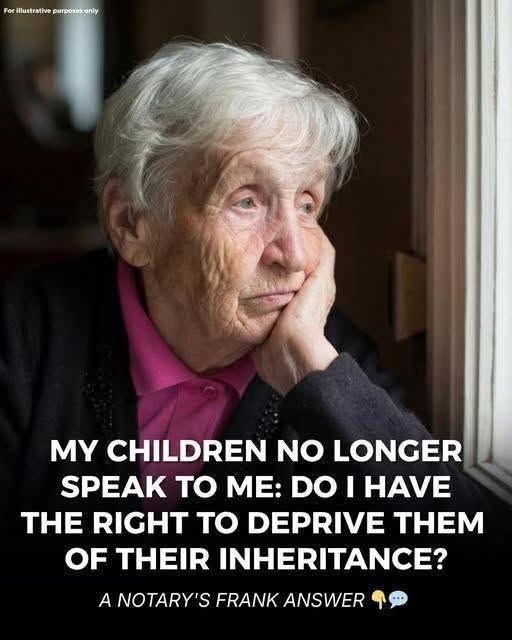
It is one of the most painful situations a parent can face — and one that is far more common than many people realize. Your children have stopped talking to you. Months have passed, perhaps years, without a phone call, without a visit, without so much as a text message acknowledging that you exist.
You raised them, sacrificed for them, loved them in ways that were not always perfect but were always real. And now, silence. The estrangement may have happened gradually, one missed holiday at a time, until you realized one day that the relationship had simply ceased to exist. Or it may have happened abruptly, with a falling-out that left you confused and grieving in a way that is hard to explain to people who have not experienced it themselves.
And now, as you sit with the paperwork of your estate plan in front of you, or simply with the thought forming quietly in the back of your mind, you find yourself asking a question that carries enormous weight: do I have the right to leave them nothing?

Advertisement
The short answer, in most countries and most legal systems, is yes. You generally do have that right. But the full answer is considerably more nuanced, and the decision — if you choose to make it — carries practical, emotional, and relational dimensions that are worth thinking through carefully before you act. This is not a simple question of legal entitlement. It is a question about what kind of legacy you want to leave, what message you want your final decisions to send, and what consequences — intended and unintended — may follow from the choices you make now.
The Legal Reality: You Are Not Obligated to Leave Them Anything
In the United States, unlike in some European countries that have “forced heirship” laws guaranteeing adult children a minimum share of their parents’ estates regardless of circumstances, the law generally allows parents to distribute their assets however they choose. An adult child — one who is no longer a minor and is not financially dependent on you — has no automatic legal claim to your property or other assets unless you specifically leave those assets to them in a will or a trust. The fact that they are your biological or adopted child does not, in and of itself, create an inheritance right under American law. The decision is yours to make.
This is important to understand clearly, because many parents carry a vague assumption — sometimes even a guilty sense of obligation — that their children are entitled to whatever they leave behind simply by virtue of the relationship. That assumption is not legally accurate in most U.S. jurisdictions. As long as you are mentally competent at the time you create or update your estate documents, and as long as the assets in question belong to you, you have the right to decide who receives them after your death. Your estranged adult children may be upset by that decision. They may even challenge it. But the legal foundation for disinheritance of an adult child, when done correctly and explicitly, is solid in most states.
see you next page