This procedure is called aspiration.
The clinician inserts a needle into the cyst and removes the fluid.
It can reduce the size of the lump and may relieve pressure or discomfort.
However, aspiration doesn’t necessarily remove the connection between the cyst and the underlying joint or tendon structure.
Because of that, the cyst can come back.
This is one reason aspiration isn’t always a permanent solution.
Treatment Option 4: Surgery
If a ganglion cyst is causing significant or persistent problems, surgical removal may be considered.
During surgery, the cyst is removed along with part of its connection to the joint or tendon sheath when appropriate.
Surgery can reduce the chance of recurrence compared with simply draining the cyst, but recurrence is still possible.
As with any procedure, surgery has potential risks, including:
Infection
Bleeding
Scarring
Nerve or blood-vessel injury
Persistent pain
Stiffness
Recurrence
The decision should therefore be based on symptoms and individual circumstances rather than simply the presence of a lump.
Never Try to Smash a Wrist Cyst Yourself
You may encounter old advice suggesting that a ganglion cyst can be “popped” or struck with a heavy object.
Don’t do this.
Attempting to rupture a cyst yourself can cause:
Skin injury
Infection
Bleeding
Nerve damage
Damage to nearby structures
Significant pain
Even if the lump temporarily becomes smaller, that doesn’t mean the underlying problem has been safely treated.
If the lump is bothersome, medical treatment is much safer than trying to crush it at home.
Could It Be Something Other Than a Ganglion Cyst?
Yes.
This is particularly important when the appearance doesn’t fit the usual pattern.
A healthcare professional may consider other causes when a lump is:
Very hard
Fixed in place
Rapidly enlarging
Associated with significant redness or warmth
Extremely painful
Associated with fever
Causing progressive weakness or numbness
Appearing after significant trauma
Most wrist lumps are not cancer.
But “probably harmless” isn’t the same thing as “definitely a ganglion cyst.”
An examination is the best way to determine what you’re dealing with.
When Should You See a Doctor?
Consider getting a wrist lump evaluated if:
You don’t know what caused it
It continues to grow
It becomes painful
It limits wrist movement
It interferes with work or exercise
You develop numbness or tingling
Your grip becomes weaker
It repeatedly disappears and returns
The skin over it becomes abnormal
A doctor may be able to recognize a typical ganglion cyst through examination.
If the diagnosis isn’t clear, imaging such as an ultrasound or MRI may sometimes be used.
Redness, Warmth and Fever Are Different
A typical ganglion cyst is not usually associated with significant redness, warmth, or systemic illness.
If a lump becomes:
Red
Hot
Very painful
Rapidly swollen
especially when accompanied by fever or feeling unwell, infection or another inflammatory problem needs to be considered.
That situation should be evaluated promptly.
What About a Lump That Causes Numbness?
This is another reason not to ignore certain symptoms.
A ganglion cyst can sometimes press against a nearby nerve.
Nerve compression may produce:
Tingling
Pins-and-needles sensations
Numbness
Burning sensations
Weakness
Changes in grip
However, nerve symptoms can also arise from problems elsewhere, including the neck, elbow, or wrist.
So don’t assume that a cyst is automatically responsible.
A medical evaluation can help identify the source.
Can Exercise Make It Worse?
It depends on the individual.
Some people notice that repetitive wrist activity makes the cyst more prominent or uncomfortable.
Activities involving frequent:
Typing
Gripping
Lifting
Push-ups
Weight training
Racquet sports
Repetitive wrist bending
may aggravate symptoms in some people.
That doesn’t mean you have to stop all physical activity permanently.
Instead, if an activity consistently causes pain, temporarily reducing the aggravating movement and discussing appropriate modifications with a healthcare professional may be helpful.
What About Massage?
Gentle massage around the surrounding muscles may feel relaxing for some people, but directly pressing aggressively on a wrist lump isn’t necessarily helpful.
A cyst is not something that should be forcefully squeezed or manipulated.
If the lump is painful, a healthcare professional can advise whether massage, stretching, strengthening, or temporary activity modification is appropriate.
Does a Ganglion Cyst Mean Your Joint Is Damaged?
Not necessarily.
A ganglion cyst can occur around an otherwise functional joint.
In some people, it may be associated with underlying joint irritation or degenerative changes.
But simply having a ganglion cyst doesn’t automatically mean your wrist is seriously damaged.
That’s another reason why a proper assessment is more useful than assuming the worst.
Can Ganglion Cysts Come Back?
Yes.
Even after aspiration or surgical treatment, ganglion cysts can recur.
Recurrence depends on several factors, including the cyst’s location, its connection with surrounding structures, and the treatment used.
If a cyst returns, that doesn’t automatically mean something dangerous has happened.
It may simply mean that the underlying connection allowed fluid to accumulate again.
Living With a Ganglion Cyst
If your healthcare provider confirms that the lump is a ganglion cyst and it’s not causing significant symptoms, you may be able to live with it without treatment.
Practical measures can include:
Avoiding activities that clearly aggravate pain
Taking breaks during repetitive wrist activity
Maintaining comfortable wrist positioning
Following any recommended exercises
Monitoring changes in size or symptoms
Seeking reassessment if symptoms change
For many people, the biggest challenge is simply the anxiety caused by seeing a lump.
Once its nature is confirmed, that uncertainty often becomes easier to manage.
Nguyên nhân u bao hoạt dịch khớp cổ tay | BvNTP
The Bottom Line
A bump on your wrist can understandably make you nervous.
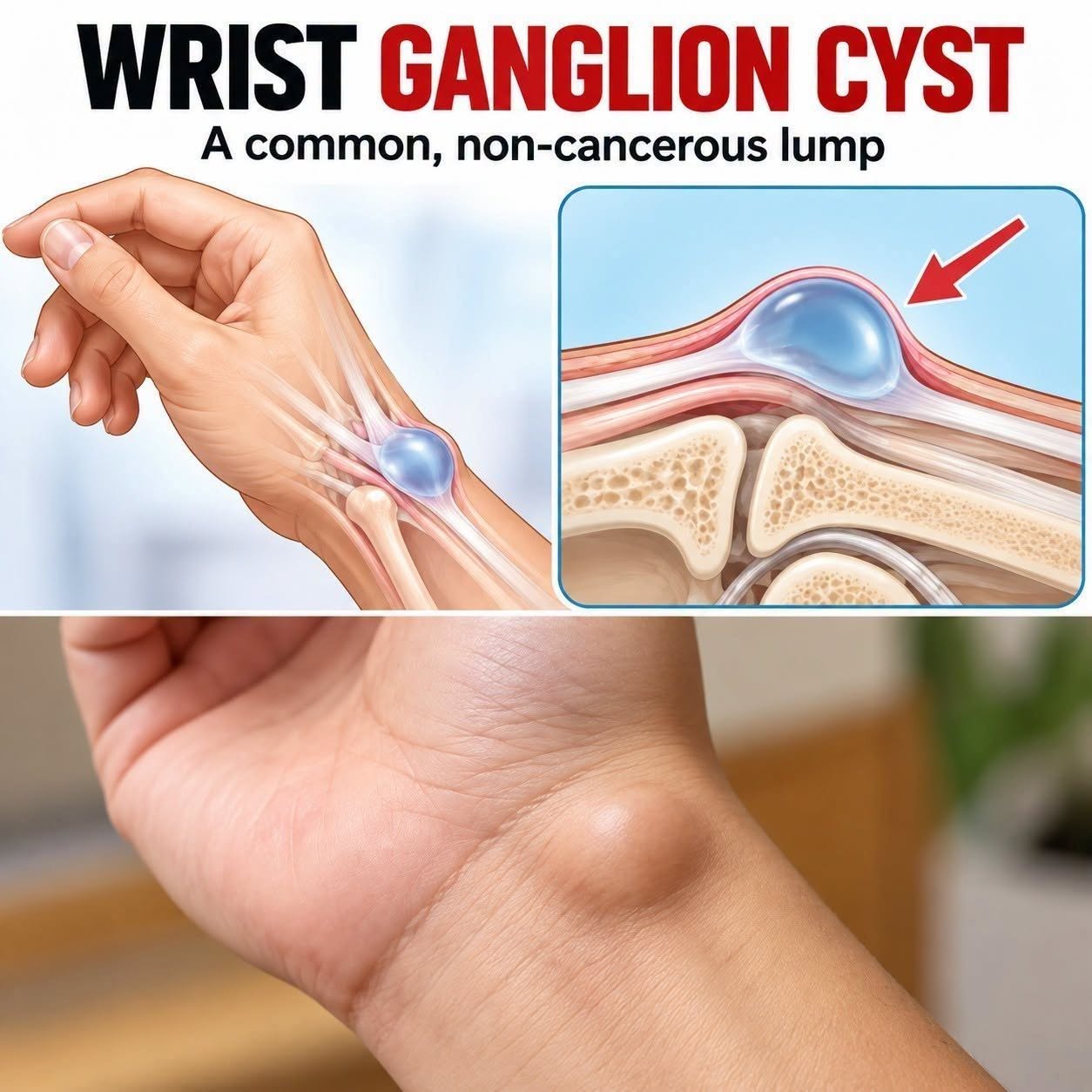
But if it turns out to be a ganglion cyst, there’s reassuring news: ganglion cysts are common, benign, fluid-filled lumps and are not cancerous.
Many don’t require treatment at all.
Some disappear on their own, while others remain stable for long periods.
When symptoms occur, treatment options can include observation, temporary support, aspiration, or — in selected cases — surgical removal.
The most important thing is not to assume that every wrist lump is a ganglion cyst.
If you notice a new, growing, painful, unusually hard, fixed, red, or unexplained lump, especially if it is accompanied by numbness, weakness, fever, or significant changes in movement, have it evaluated.
And remember: a lump doesn’t automatically mean something dangerous.
Sometimes, what looks alarming at first is simply a small fluid-filled cyst that can be monitored or treated when necessary.