
Part 1:
I always assumed the young goth woman who visited my mother every Saturday was simply an unusual new friend.
After Mom died, I discovered their relationship had begun because of something much deeper.
And the more I learned, the more I realized my mother had spent years carrying a regret none of us had completely understood.
Raven waited until almost everyone had left the funeral before approaching me.
Throughout the service, I had tried not to watch her.
She remained near the back of the room in a long black coat, silver rings and piercings catching the light whenever she moved.
For months, I had seen her sitting at Mom’s kitchen table every Saturday as though she belonged there.
I had never understood why.
Now my mother was gone, and Raven was walking toward me with one hand tightly closed.
“Maeve.”
I turned.
Her eyes were swollen from crying.
“Thank you for coming,” I said.
She nodded and slowly opened her palm.
A tiny brass key rested there.
I frowned.
“What’s this?”
“Your mother told me to give it to you after she died.”
My stomach tightened.
“What does it open?”
“She said you’d understand once you found it.”
I stared at her.
“Why didn’t Mom give it to me herself?”
Raven hesitated.
“Maybe because she thought you’d put it somewhere safe and avoid finding out what it was for.”
The comment stung.
“You don’t know me.”
“No,” Raven replied quietly. “But Doris did.”
For a moment, grief turned into irritation.
“Then why did my mother trust you with this?”
Raven’s expression softened.
“I didn’t know her better than you did.”
“Then why do you have the key?”
“Because I knew a part of her you didn’t.”
Before I could ask what she meant, my husband, Tom, appeared carrying my coat.
Raven stepped away.
“Don’t hide the key in a drawer.”
Then she left.
I remained standing there, the metal key pressed into my palm.
One question wouldn’t leave me.
What had my mother been hiding?
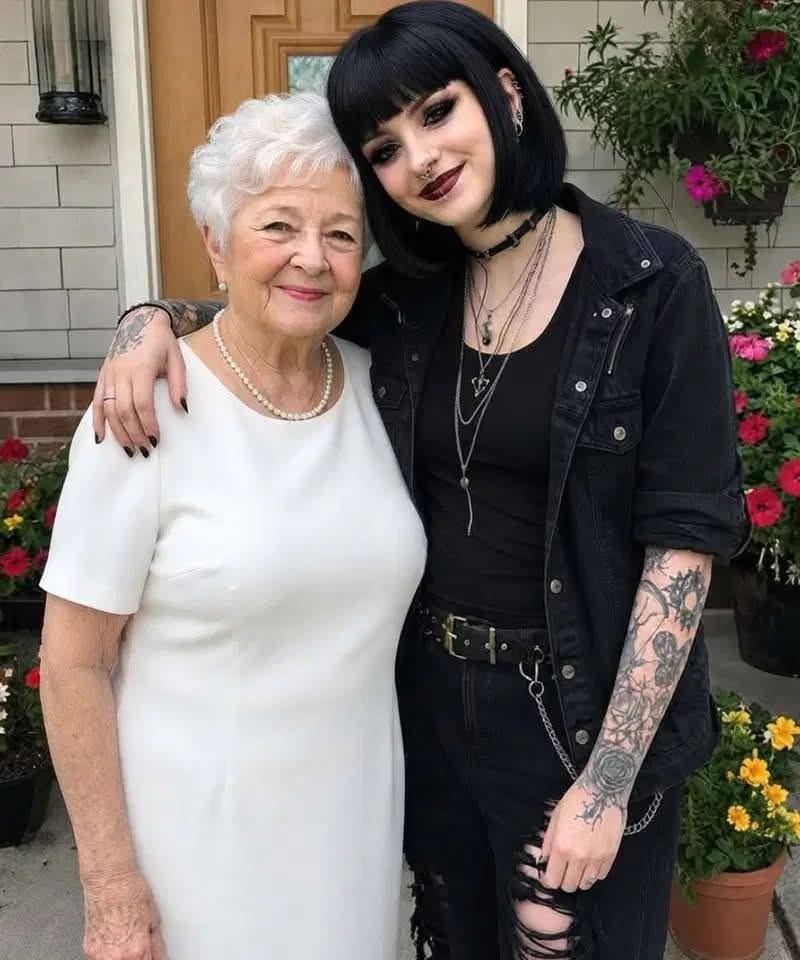
The first time I met Raven, she was sitting in my father’s old chair drinking tea from Mom’s best china.
I had walked into the kitchen carrying groceries and stopped immediately.
“Mom?”
My mother, Doris, looked up.
At seventy-three, she was still happiest in that little kitchen surrounded by books, tea, and the garden outside.
“There you are, Maeve.”
The woman beside her turned.
She couldn’t have been much older than twenty-five.
Black clothes covered her from neck to boots.
Tattoos ran along both forearms, and several silver piercings reflected the afternoon light.
“This is Raven,” Mom said. “She’s a friend.”
Raven stood politely.
“Nice to meet you.”
“You too.”
But my attention kept returning to Dad’s chair.
Raven noticed.
“Am I sitting somewhere I shouldn’t?”
“No,” I said quickly. “It’s fine. How exactly do you two know each other?”
“We met over coffee,” Mom answered.
“At the bookstore café,” Raven added. “She told me the novel I was reading was terrible.”
Mom smiled.
“It was terrible.”
I tried to laugh, but something bothered me.
“I thought we were spending the afternoon together.”
Mom’s smile faded.
“We can do that next Saturday.”
I stared at her.
“You’re asking me to leave?”
“We’re discussing something private.”
Raven immediately offered to go.
But Mom stopped her.
“No.”
That hurt more than it probably should have.
I grabbed my purse.
“Maeve,” Mom said gently. “I love you. But I don’t need you managing every part of my life.”
“Saturdays are usually ours.”
“I know.”
I glanced at Raven, then Mom.
“Fine. I’ll get out of your way.”
Before leaving, I noticed a small wooden box beside Raven’s elbow.
Mom quickly covered it with a dish towel.
That did absolutely nothing to reassure me.
“Fine,” I repeated.
Mom sighed.
“There it is again.”
“What?”
“That word you say when nothing is actually fine.”
I left before anger made me say something I would regret.
That evening, I complained to Tom.
“She was there again.”
“Raven?”
“Two Saturdays in a row.”
Tom looked at me carefully.
“Did your mother seem upset?”
“No. That’s almost what bothers me.”
“Why?”
“Because she looked completely comfortable with her. Happy, even. And I still don’t know who Raven really is.”
Tom waited.
“She’s twenty-something,” I continued. “Mom barely knows her, and suddenly they’re having private conversations every weekend.”
“Do you think Raven wants money?”
“I don’t know.”
“Has Doris given you any reason to believe she’s being manipulated?”
“No.”
Tom leaned closer.
“Then what’s really bothering you?”
I stared into my tea.
Finally, I admitted it.
“I feel excluded.”
“Because you’re worried?”
“Because I’m jealous.”
Tom reached across the table and touched my hand.
“Then stop guessing. Pay attention.”
So I did.
Raven kept returning.
Soon Saturdays clearly belonged to them.
One afternoon, I arrived early and saw birthday cards scattered across Mom’s kitchen table.
The moment she noticed me, she quickly gathered them into a wooden box.
“What are those?”
“Old things.”
Part 2:
I started wiping down the counter out of habit.
Mom touched my wrist.
“Not everything needs you to fix it.”
“I’m not fixing anything.”
She gave me a tired smile.
“You usually are.”
Then one Saturday, I accidentally left my phone at Mom’s house.
When I returned an hour later, I entered through the side door and heard voices coming from the kitchen.
Raven was speaking.
“You tell me every week to call my mother.”
“I know,” Mom replied.
“Then call your sister.”
I froze.
She meant Aunt Elaine.
Mom and Elaine hadn’t spoken in eleven years.
Their relationship had collapsed after my grandmother became ill.
Mom had handled most of Grandma’s care and grew resentful because Elaine lived farther away and couldn’t help as often.
During one terrible argument, Elaine had said something that Mom never forgave.
“You don’t help people because you’re generous, Doris. You help them so they owe you.”
Mom told her to leave.
Grandma died shortly afterward.
Neither sister called the other again.
Now Raven was challenging Mom about it.
“You ask me every Saturday whether I’ve called my mother,” Raven said.
“I know.”
“So why haven’t you called Elaine?”
Silence.
“That’s different.”
“How?”
Mom sighed.
“It simply is.”
But Raven refused to let her escape.
“Have you ever tried?”
“Once.”
“What happened?”
“I picked up the phone.”
“And called her?”
“No.”
Raven paused.
“So you picked up the phone.”
“And then I put it down.”
“That isn’t exactly following your own advice.”
Mom laughed softly.
“No. It isn’t.”
Raven’s voice became gentler.
“Then why keep telling me to contact my mother?”
Mom answered after a long silence.
“Because sometimes you can be right, Raven, or you can still have your family. Sometimes life doesn’t let you have both.”
“That’s pretty rich coming from you.”
“I know.”
My hand rested against the kitchen door.
I could have walked in.
I could have spoken Elaine’s name and forced the entire subject into the open.
Instead, I quietly backed away.
That evening, I wrote a message to Elaine.
“I saw Mom today. I think she misses you.”
I stared at it until my phone screen dimmed.
Then I deleted it.
Two months later, Mom suffered a stroke.
Tom met me outside her hospital room after the doctor came out.
He pulled me against him.
For one strange second, instinct took over.
“I need to call Mom.”
Then reality returned.
Mom was gone.
I stepped back and opened my contacts.
“I have to call Elaine.”
She answered on the fifth ring.
“Maeve?”
“Mom died this morning.”
Silence.
Then I heard her breathe.
“Oh, God.”
“The funeral is Friday.”
“I don’t think I can come.”
Normally, I would have immediately said I understood.
I would have ended the uncomfortable conversation.
This time, I didn’t.
“I want you there.”
“I can’t promise.”
“Then don’t promise. Just think about it.”
She didn’t come.
After the funeral, I stood at my desk staring at the brass key Raven had given me.
Tom watched.
“You’re going to put it away?”
“I was.”
“What changed?”
I closed my hand around it.
“I’m tired of protecting things instead of understanding them.”
We drove to Mom’s house.
I searched her desk.
Nothing.
Her sewing cabinet.
Nothing.
Finally, I went upstairs.
Behind several folded blankets in her bedroom closet sat a wooden box.
The brass key fit perfectly.
Inside were dozens of envelopes.
Every one was addressed to Elaine.
Tom picked one up.
“Eleven years?”
I nodded.
“She wrote to her for eleven years.”
“But never sent them.”
My phone was already in my hand.
This time, I didn’t let myself hesitate.
I called Elaine.
When she answered, I said:
“I found something Mom spent eleven years hiding from both of us.”
Elaine arrived the following afternoon.
Tom let her inside and then deliberately gave us privacy.
I led her upstairs.
The moment Elaine saw the envelopes spread across Mom’s bed, she stopped.
“You found them?”
I turned.
“You knew?”
“Not those.”
She walked closer and picked up one of the birthday cards.
“I have a box too.”
I stared at her.
“A box of what?”
“Letters to Doris. Christmas cards. Birthday cards. Things I wrote but never mailed.”
“Why?”
Elaine looked down.
“Because every time I finished one, I imagined her sending it back unopened.”
I could hardly believe what I was hearing.
“So the two of you spent eleven years writing to each other without ever actually speaking?”
Her mouth tightened.
“Apparently.”
I began sorting Mom’s cards by year.
Elaine watched me.
Then she suddenly asked:
“Do you remember when I called you five years ago on Doris’s birthday?”
My stomach tightened.
“You asked how she was.”
“I asked whether she ever talked about me.”
I already knew what was coming.
“What did you tell me, Maeve?”
I looked at her.
“Not really.”
Elaine’s eyes filled.
“Do you know what I heard when you said that?”
I didn’t answer.
“I heard that my sister had forgotten me.”
“Aunt Elaine…”
“Was it true?”
There was no easy answer anymore.
“No.”
She froze.
Mom had spoken about Elaine often.
She would see a sweater and say Elaine would love it.
She remembered birthdays.
She mentioned childhood stories.
She missed her sister.
Elaine swallowed hard.
“So when I asked if she ever mentioned me…”
“I gave you the easiest answer.”
“Why?”
“Because I was exhausted from feeling caught between you.”
Her face hardened.
“I wasn’t asking you to repair our relationship, Maeve.”
“I know that now.”
“You let me believe she was finished with me.”
“I did.”
Elaine stared at the pile of cards.
“I need to leave.”
“Aunt Elaine—”
“Not now.”
She walked out.
I remained sitting on Mom’s bed for a long time.
Eventually, I began returning the envelopes to the box.
That was when I noticed one wedged beneath the fabric lining.
It was sealed.
Elaine’s name was written across the front in Mom’s handwriting.
I could have opened it.
I didn’t.
That evening, I asked Raven to come over.
She sat at Mom’s kitchen table in the same chair where I had first seen her.
“How did you and Mom really become friends?”
“She insulted my book.”
Despite everything, I smiled.
“That definitely sounds like her.”
Raven smiled too.
“We started talking. I told her my mother and I weren’t speaking because she hated that I left college to become a tattoo artist.”
“And Mom told you about Elaine?”
“Yes.”
“So she kept telling you to call your mother.”
“Every Saturday.”
“And you kept telling her to call Elaine.”
“Pretty much.”
I looked at my hands.
“Why didn’t she tell me?”
Raven hesitated.
“She was embarrassed.”
“About what?”
“You’d been telling her for years to contact Elaine. She kept refusing. Then someone she barely knew told her the same thing, and suddenly she wanted to try.”
Raven leaned forward.
“Maeve, your mother didn’t choose me instead of you.”
I looked up.
“She was simply less ashamed to admit she was frightened to someone who hadn’t watched her spend years pretending she wasn’t.”
That stayed with me.
The next morning, I drove to Elaine’s house.
Mom’s sealed letter was inside my purse.
When Elaine opened the door, her expression hardened.
“I told you I needed time.”
“I know.”
“Then why are you here?”
I held out the envelope.
“I found this after you left.”
She stared at her name.
“Did you read it?”
“No.”
Her eyes lifted.
“There’s nothing left to repair between Doris and me.”
“No,” I said. “There isn’t.”
She frowned.
“Mom died before either of you found the courage to speak. I can’t change that.”
“Then what do you want?”
“Nothing.”
That surprised her.
“I came because I need to say something without defending myself.”
My throat tightened.
“Five years ago, when you asked whether Mom talked about you, I knew she did.”
Part 3:
Elaine went still.
“I knew she missed you. I gave you the easiest answer because I didn’t want to deal with whatever might happen afterward.”
“So you lied.”
“Yes.”
“You let me believe she didn’t care.”
“Yes.”
Anger flashed across her face.
For once, I didn’t explain myself.
I didn’t try to soften what I had done.
“I’m not asking you to forgive me,” I said. “But I’m finished pretending silence doesn’t have consequences.”
I placed Mom’s envelope beside her door.
“This belongs to you.”
Then I left without telling her whether she should read it.
Three weeks later, Elaine came to Mom’s house.
She sat across from me at the kitchen table.
The wooden box rested beside her chair.
“I read the card.”
I waited.
“She said she’d wasted years waiting until she knew exactly what she wanted to say.”
Elaine stared into her coffee.
“Then she wrote that maybe waiting was the entire problem.”
“What else?”
Elaine’s voice softened.
“She missed me.”
I almost reached for her hand but stopped.
“I’m sorry.”
She nodded.
“I wrote almost exactly the same thing to her last year.”
That evening, Raven sent me a message.
“I finally called my mom. We’re having dinner tomorrow. Wish me luck.”
I smiled and put my phone down.
Elaine turned one of Mom’s old cards between her fingers.
“I don’t know what happens between us now.”
“Neither do I.”
I swallowed.
“But I’d like to see you again, if you want that.”
She looked at me.
“No pressure,” I added. “I think I’ve spent enough time trying to control how everyone else fixes things.”
Her expression softened.
I thought about how jealous I had once been of Raven.
A woman half my age.
A stranger I believed had somehow taken my place in my mother’s life.
But Raven hadn’t replaced me.
She had simply known one part of Mom that I hadn’t been invited to see.
Maybe loving someone for an entire lifetime doesn’t mean knowing every corner of them.
Elaine picked up her coffee.
“Call me next week.”
“I will.”
And this time, I meant it.
Because for once, instead of trying to repair everyone around me, I was finally ready to work on the person I could actually change.
Myself.
