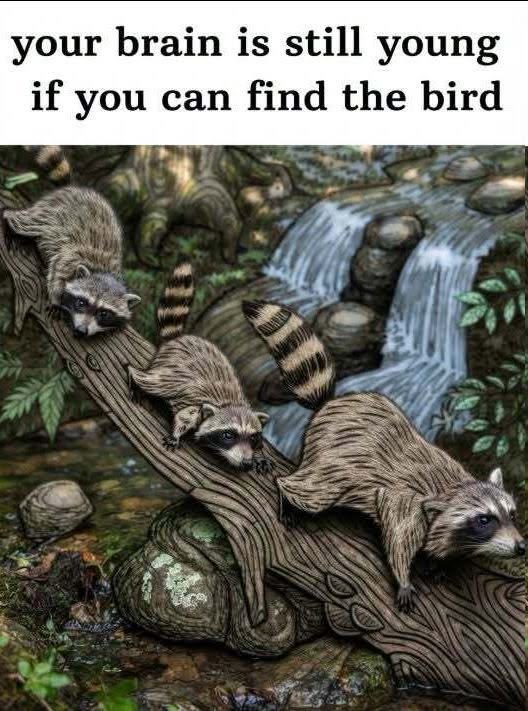
At first glance, this black-and-white nature drawing looks like a peaceful forest scene filled with playful raccoons, a fallen tree, rocks, leaves, and a small stream.
But take another look.
Somewhere among all those carefully arranged lines and natural shapes is a hidden bird, and finding it may be much harder than you expect!
The headline suggests that your brain is still young if you can spot the hidden bird. That certainly makes the challenge sound intriguing, but spotting a hidden figure isn’t a scientific test of your brain’s age. Optical illusions like this are really about visual attention, pattern recognition, and how quickly your eyes can separate one shape from another.
And that’s what makes this puzzle so much fun.
Your eyes naturally want to focus on the most obvious parts of the illustration—the raccoons, their striped tails, the tree trunk, rocks, leaves, and flowing water. Meanwhile, the bird is cleverly disguised among the surrounding shapes.
So, before you scroll for the answer, give yourself a few moments.
Can you find the hidden bird?
Look Closely at the Raccoon Forest
The illustration is packed with visual distractions.
There are raccoons scattered throughout the scene, each with distinctive features that immediately grab your attention. Their dark masks, rounded bodies, and striped tails create plenty of recognizable shapes for your brain to process.
Then there is the fallen tree.
Its twisting branches and textured bark add another layer of visual noise. Rocks, plants, leaves, and the little stream make the scene even more complicated.
And that’s exactly what makes the hidden bird so easy to miss.
Instead of appearing as a clearly outlined bird sitting on a branch, the figure is incorporated into the surrounding artwork.
Your brain sees the forest first.
The bird has to wait.
Can You Find the Hidden Bird?
Before looking for clues, try solving the puzzle yourself.
Take a slow look across the entire illustration.
Don’t just stare at the raccoons. Move your eyes from one side of the picture to the other. Examine the spaces between objects, the edges of the tree, and areas where several lines seem to overlap.
Sometimes it helps to stop looking for a literal bird.
Instead, look for an unusual arrangement of lines that could form a bird’s head, body, wings, or beak.
Give yourself at least 30 seconds.
Then try again.
Did you find it?
Why Is the Hidden Bird So Difficult to See?
This type of visual puzzle works because our brains are constantly trying to organize what we see.
When an image contains familiar objects, we tend to recognize those objects quickly.
A raccoon looks like a raccoon.
A tree looks like a tree.
A rock looks like a rock.
Once your brain has decided what you’re looking at, it may not immediately consider whether those same lines could also form another object.
That’s where the hidden bird gets an advantage.
Your eyes focus on the obvious objects
The raccoons are visually interesting and easy to recognize, so they’re natural attention magnets.
You may spend most of your time examining their faces and tails without realizing that the bird is hiding elsewhere.
The bird blends into the artwork
The hidden figure doesn’t necessarily have the strong contrast you’d expect from a normal bird illustration.
Instead, its shape is incorporated into the surrounding linework.
The picture contains lots of visual information
The more details an illustration contains, the more possibilities your eyes have to explore.
Branches, fur, rocks, leaves, shadows, and water all create competing shapes.
That makes the hidden bird even easier to overlook.
Try This Simple Trick
If you’re struggling, don’t keep staring at the same spot.
Instead, change the way you’re looking at the picture.
Scan from left to right
Move your eyes slowly across the illustration rather than jumping randomly between objects.
Look at the negative spaces as carefully as the objects themselves.
Look at the outlines
Pay attention to unusual curves and angles.
A hidden animal may be created by lines that initially appear to belong to a completely different part of the picture.
Step back
If you’re viewing the puzzle on a phone or computer, move slightly farther away from the screen.
Sometimes the larger overall pattern becomes easier to recognize when you’re not examining every tiny detail.
Turn your attention away from the raccoons
This is a big one!
The raccoons are probably the first things you’ll notice, but they may also be the biggest distraction.
Force yourself to examine the rest of the scene.
Did You Find It?
If you spotted the bird without help, congratulations!
You successfully resisted the distraction created by all those raccoons and natural details.
If you didn’t find it, don’t worry.
That’s part of the fun.
These puzzles aren’t a formal test of intelligence, memory, or biological brain age. Someone can spot the bird immediately simply because their eyes happened to land on the right shape first.
Another person might stare at the same picture for several minutes before suddenly seeing it.
And once you finally see the hidden bird?
It’s one of those funny optical-illusion moments when you wonder:
“How did I not see that before?”
The Hidden Bird May Be Easier Once You Know What to Look For
One of the most interesting things about hidden-object puzzles is how dramatically your perception can change after the answer is revealed.
Before finding the bird, you may see nothing but random lines.
After finding it, those same lines suddenly make sense.
Your brain essentially changes its interpretation of the image.
That’s why these puzzles can feel almost magical.
The picture itself hasn’t changed.
Your perception of it has.
Does Finding the Bird Mean Your Brain Is Still Young?
Not literally.
The phrase makes for a catchy challenge headline, but successfully finding a hidden bird isn’t a reliable way to determine someone’s brain age.
Visual puzzles can involve several skills, including:
Visual attention
Pattern recognition
Figure-ground perception
Concentration
Processing of complex images
Ability to shift attention between different parts of a scene
People also have different experiences with visual puzzles.
Someone who enjoys optical illusions may already know to search for unusual shapes and negative space. Someone seeing this type of puzzle for the first time may naturally spend more time looking at the obvious objects.
So don’t worry if the bird refuses to reveal itself.
Your brain hasn’t failed the test.
You may simply need to look at the picture differently!
Why Hidden-Object Puzzles Are So Addictive
There is something incredibly satisfying about solving a visual puzzle.
At first, you’re confused.
Then you become determined.
You start scanning every corner.
Maybe you even say, “There’s no bird in here!”
And then suddenly—you see it.
That little moment of discovery is what keeps people coming back for another puzzle.
They encourage careful observation
Instead of casually glancing at a picture, you have to slow down and inspect the details.
They make familiar scenes feel unfamiliar
A forest filled with raccoons sounds simple enough.
But when an additional animal is hiding within the artwork, suddenly every branch and shadow becomes suspicious.
They create an instant “aha!” moment
The best hidden-object puzzles have that wonderful quality where the answer seems obvious immediately after you discover it.
How Long Did It Take You?
see continuation on next page
For Complete Cooking STEPS Please Head On Over To Next Page Or Open button (>)
ADVERTISEMENT
See next page:
Next →