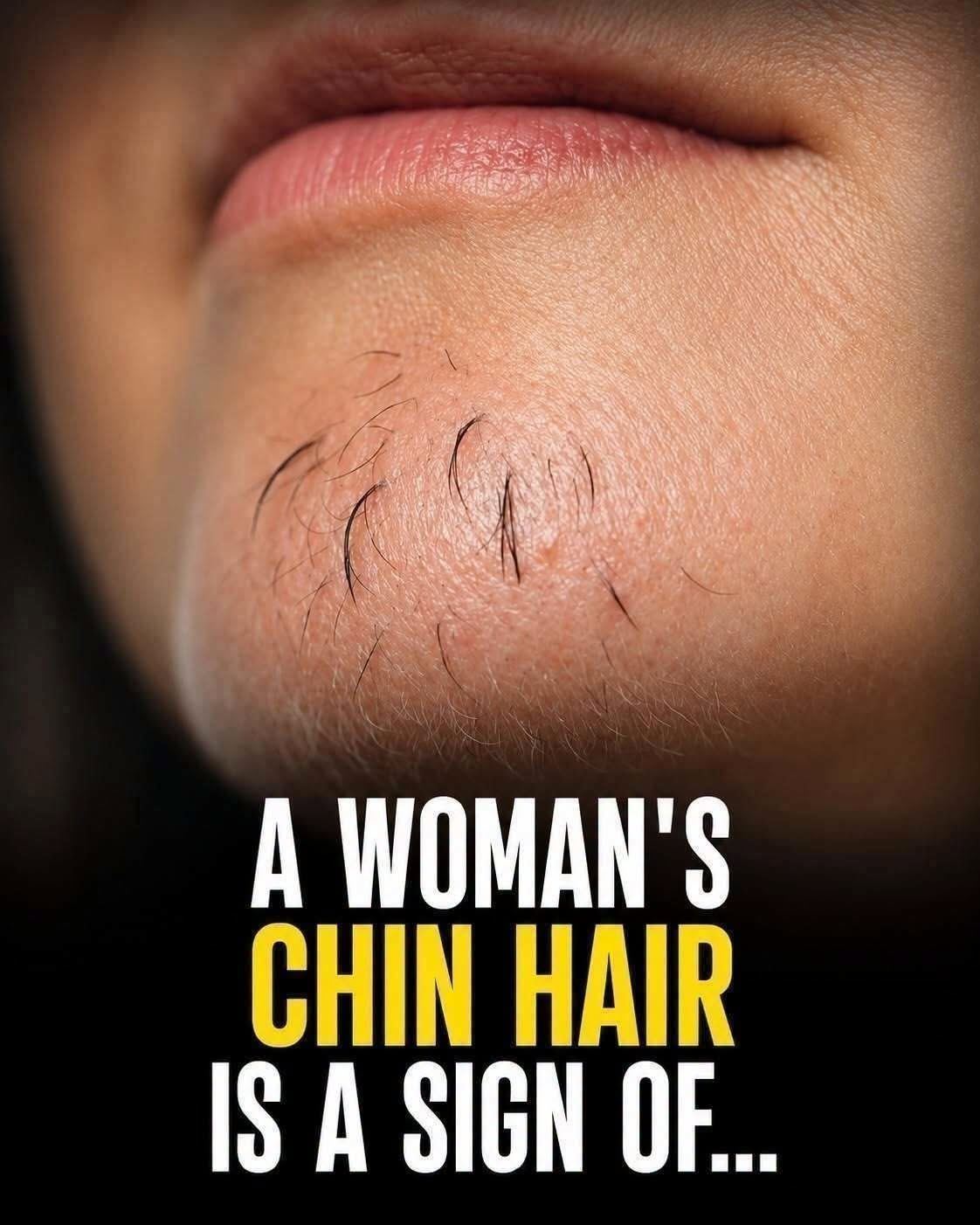
A Woman’s Chin Hair Is a Sign of What? What Facial Hair Can Really Tell You
You look in the mirror and notice it.
One dark, coarse hair on your chin.
You pluck it.
A few days later, another appears.
Then another.
For many women, facial hair—especially around the chin, jawline, or upper lip—can be surprising and sometimes embarrassing. It can also lead to an alarming question:
“Is my chin hair a sign that something is wrong with my hormones?”
The answer is sometimes yes—but not always.
A few chin hairs do not automatically mean that you have a hormone disorder, polycystic ovary syndrome (PCOS), or another serious health condition. Hair growth varies naturally between women, and genetics, age, hormonal changes, medications, and ethnicity can all influence how much facial hair a person develops.
However, when facial hair becomes noticeably darker, thicker, or more abundant—particularly when the change happens fairly quickly—it can sometimes be a condition called hirsutism.
And in some women, hirsutism can be a clue that androgen hormones are playing a role.
So what exactly does chin hair mean?
Let’s separate the everyday reality from the medical warning signs.
First: Chin Hair Can Be Completely Normal
Women naturally have hair on their faces.
The difference is often the type of hair.
Fine, light-colored hair is called vellus hair. It can cover much of the face and is usually barely noticeable.
Terminal hair, on the other hand, is thicker, darker, and more noticeable.
A woman may naturally develop a few terminal hairs on her chin or upper lip without having a medical disorder.
Genetics can have a major influence on body and facial hair.
Age also matters.
Hormonal changes throughout adulthood can alter the balance between estrogen, testosterone, and other hormones. As women get older, changes in ovarian hormone production can make facial hairs more noticeable.
Therefore, finding one or several chin hairs doesn’t automatically mean something is medically wrong.
The important question is whether there has been a significant change from your normal pattern.
What Is Hirsutism?
The medical term for excessive coarse hair growth in a male-pattern distribution is hirsutism.
It can affect areas such as the:
Chin
Upper lip
Jawline
Chest
Lower abdomen
Back
Inner thighs
Hirsutism is generally related to increased androgen activity.
Androgens are hormones that are present in both men and women. Testosterone is one of the best-known androgens.
Women naturally produce androgens, but if androgen levels are elevated—or if hair follicles are particularly sensitive to them—coarser hair can develop in areas where men typically grow more terminal hair.
Mayo Clinic notes that hirsutism often becomes noticeable around the mouth and chin and can be associated with excess androgen activity.
That doesn’t mean every woman with facial hair has high testosterone.
Sometimes hormone levels are normal, but the hair follicles are more sensitive to the hormones.
Could Chin Hair Be Related to PCOS?
One of the most commonly discussed conditions associated with hirsutism is polycystic ovary syndrome, commonly known as PCOS.
PCOS is a hormonal and metabolic condition that can affect ovulation and androgen activity.
Extra facial or body hair can be one of its symptoms.
But chin hair by itself is not enough to diagnose PCOS.
Other signs may include:
Irregular menstrual periods
Infrequent periods
Difficulty becoming pregnant
Acne
Thinning hair on the scalp
Increased facial or body hair
Changes associated with insulin resistance
Mayo Clinic describes excessive androgen-related hair growth as one possible feature of PCOS, while also emphasizing that symptoms vary between individuals.
This distinction is important.
A woman can have a few chin hairs and not have PCOS.
Another woman might have significant facial hair along with irregular periods and acne, making a hormonal evaluation more appropriate.
The pattern matters more than one isolated hair.
Why Does It Sometimes Appear With Age?
Many women notice facial hair becoming more prominent during midlife.
This can happen because hormonal patterns change as women age.
The balance between estrogen and androgens can shift, and individual hair follicles may respond differently.
This doesn’t necessarily indicate illness.
It can be part of normal biological aging.
The same person who had almost invisible facial hair at 25 might notice several darker hairs at 40, 50, or later.
That can be frustrating, but it isn’t automatically dangerous.
What deserves more attention is a rapid and dramatic change.
When Facial Hair Deserves Medical Attention
Doctors are generally more interested when facial or body hair becomes noticeably heavier over a relatively short period.
Mayo Clinic recommends medical evaluation when women develop heavy or rapidly increasing facial or body hair, particularly if other signs of androgen excess appear.
Pay particular attention if new coarse facial hair appears together with symptoms such as:
Irregular or absent periods
New or severe acne
Thinning hair on the scalp
A noticeable increase in muscle mass
A deeper voice
Other rapid physical changes
These symptoms don’t tell you what the cause is by themselves.
But together, they can give a doctor useful information.
What About a Sudden Explosion of Facial Hair?
A sudden and substantial increase in coarse facial hair deserves more attention than a few isolated hairs appearing gradually.
There are several possible explanations.
Hormonal disorders can cause hirsutism.
Certain medications can contribute to unwanted hair growth.
PCOS can cause gradually increasing androgen-related hair growth.
Rarely, ovarian or adrenal conditions can produce unusually high androgen levels.
Mayo Clinic lists PCOS, certain adrenal disorders, medications, Cushing syndrome, and—rarely—hormone-producing tumors among possible causes of hirsutism.
Again, the word rarely matters.
Seeing a chin hair should not make you assume that you have a tumor.
The vast majority of women with unwanted facial hair do not have such a rare cause.
The reason doctors pay attention to rapid changes is that the pattern can help distinguish ordinary hair growth from something that deserves investigation.
Could Medication Be Responsible?
Yes.
Some medications can contribute to unwanted hair growth.
Mayo Clinic lists several examples, including testosterone, DHEA, minoxidil, and danazol.
This is why a healthcare professional may ask about every medication and supplement you use.
Don’t stop a prescribed medicine simply because you notice facial hair.
Instead, discuss the change with the clinician who prescribed it.
There may be alternative explanations, and changing medication without medical guidance can create other problems.
What Does the Doctor Actually Check?
If facial hair appears excessive or is accompanied by other symptoms, a clinician may begin with a medical history and physical examination.
They may ask:
When did the hair growth begin?
Has it increased gradually or quickly?
Are your menstrual cycles regular?
Have you developed acne?
Have you noticed scalp hair loss?
Are you taking medications or hormonal supplements?
Has your weight changed significantly?
Does excessive facial hair run in your family?
Depending on the situation, laboratory testing may be considered.
The Endocrine Society’s clinical practice guideline recommends androgen testing in women with an abnormal hirsutism assessment, while noting that women with only localized unwanted hair and otherwise regular menstrual cycles may not necessarily need androgen testing.
This is why an internet symptom checklist cannot replace an individual medical evaluation.
Why Hormone Testing Isn’t Always Simple
People sometimes assume that one blood test can answer everything.
It isn’t always that simple.
Hormones fluctuate.
Different laboratories use different testing methods.
A person’s symptoms and medical history matter.
And normal testosterone doesn’t necessarily mean that facial hair has no hormonal component.
The Endocrine Society guideline discusses situations in which additional androgen testing may be considered when clinical signs suggest an endocrine disorder.
A doctor therefore looks at the whole picture rather than interpreting one number in isolation.
Is Chin Hair a Sign of High Testosterone?
It can be associated with increased androgen activity, but you cannot determine your testosterone level simply by looking at a chin hair.
A woman with several coarse hairs may have normal blood androgen levels.
Another woman with similar-looking hair may have elevated androgen levels.
Hair follicles differ in their sensitivity to hormones.
Genetics also matters.
That’s why the claim “chin hair means your testosterone is high” is too simplistic.
The correct answer is more nuanced.
Chin hair can sometimes be associated with androgen activity, but the hair itself cannot tell you exactly what your hormone levels are.
The Role of Genetics
Family history can also influence unwanted facial hair.
Some women naturally have more terminal facial hair than others.
Mayo Clinic notes that family history is among the factors associated with hirsutism.
This means that if your mother, sisters, or other female relatives have always had noticeable chin or upper-lip hair, genetics may be part of the explanation.
It doesn’t necessarily mean that something is wrong.
What About Ethnicity?
Hair growth patterns vary among populations.
Mayo Clinic notes that women of Mediterranean, Middle Eastern, and South Asian ancestry may be more likely to experience extra body hair without an identifiable medical cause.
That is another reason a doctor should consider a person’s background and normal hair pattern when assessing hirsutism.
A pattern that seems unusual in one population may be relatively common in another.
What Can You Do About Unwanted Chin Hair?
If the hair is simply cosmetic and there are no concerning symptoms, several hair-removal options are available.
These include:
Tweezing
Tweezing is inexpensive and practical for a small number of hairs.
It removes the hair from the follicle and can be useful when only a few hairs are present.
Shaving
Shaving does not make hair grow back thicker.
It simply cuts the hair at the skin surface, which can make the regrowing tip feel blunt or stubbly.
For many women, shaving is a perfectly reasonable option.
Waxing
Waxing can remove multiple hairs at once.
However, it may irritate sensitive skin and isn’t appropriate for everyone.
Threading
Threading can remove multiple facial hairs and is commonly used for areas such as the upper lip and eyebrows.
Laser Hair Reduction
Laser-based hair reduction can provide longer-lasting reduction for some people.
Results depend on factors such as hair color, skin type, device, and treatment plan.
A qualified professional should perform the treatment.
Electrolysis
Electrolysis is another professional hair-removal method and can provide permanent hair removal for treated follicles when performed appropriately.
The best method depends on the individual.
What About Home Remedies?
The internet is full of claims about lemon juice, turmeric, sugar mixtures, herbal pastes, oils, and other homemade treatments for facial hair.
Be careful.
A substance being natural doesn’t automatically make it effective or safe.
Some home remedies can irritate the skin, cause burns, or trigger pigmentation changes.
If facial hair is bothersome, established hair-removal methods are generally more predictable.
And if the hair growth is new or rapidly increasing, removing it without investigating the underlying cause may miss an important medical clue.
Does Plucking Make Chin Hair Grow Back Thicker?
This is a common concern.
Plucking does not transform a normal hair follicle into one that produces a thicker hair.
However, individual hairs can appear more noticeable when they grow back because of their shape, color, or stage of growth.
If you’re repeatedly tweezing dozens of hairs, however, irritation and ingrown hairs can become problems.
If facial hair is becoming increasingly difficult to manage, a dermatologist or other healthcare professional can discuss longer-term options.
The Most Important Clue Isn’t One Hair
Here’s the biggest takeaway from all of this:
One chin hair is not a diagnosis.
Even several chin hairs aren’t necessarily a diagnosis.
What matters is the overall pattern.
Is the hair growth slowly increasing with age?
Is it a family trait?
Are your periods regular?
Have you developed acne?
Are you experiencing scalp hair thinning?
Did the facial hair suddenly become much heavier?
Are you taking a medication that could contribute?
Those questions provide much more useful information than the presence of a single hair.
When You Should Make an Appointment
Consider speaking with a healthcare professional if you notice:
Rapid or severe new facial hair growth
Facial hair accompanied by irregular periods
New severe acne
Scalp hair thinning
Other signs of increased androgen activity
A major change in your normal hair pattern
Facial hair that is causing significant distress
Especially rapid changes deserve attention.
Mayo Clinic advises medical evaluation for heavy or rapidly developing facial or body hair and for signs of virilization such as voice deepening or other significant physical changes.
The goal isn’t to frighten you.
It’s simply to make sure that a potentially meaningful change isn’t ignored.
The Bottom Line
So, what is a woman’s chin hair a sign of?
Sometimes, it’s simply a normal variation in hair growth.
Sometimes, it reflects age, genetics, or individual sensitivity of hair follicles.
Sometimes, particularly when the growth is substantial or accompanied by other symptoms, it can be associated with increased androgen activity or conditions such as PCOS.
And rarely, it can be connected to another medical condition that requires investigation.
The important thing is not to panic over one stray hair.
At the same time, don’t ignore a dramatic change in your body.
Your normal pattern is one of the most useful clues.
If a few hairs appear gradually over the years, that may be nothing more than a normal part of getting older.
If coarse facial hair suddenly becomes much more prominent—and especially if it appears alongside irregular periods, acne, scalp hair loss, or other hormonal changes—talk with a healthcare professional.
The image of one dark hair on a chin can make for a dramatic social-media headline.
Real biology is more complicated.
A chin hair is not a diagnosis. It’s a clue—and the meaning of that clue depends on the whole picture.
Medical Disclaimer